
For decades, the concept of cybersecurity lived almost entirely within the boundaries of data protection. Companies poured resources into firewalls, antivirus platforms, and network monitoring tools with a singular, clear objective. They needed to stop threat actors from stealing proprietary data, leaking customer files, or locking up corporate business applications.
A completely different category of technology handles the heavy lifting behind the scenes of modern civilization. This architecture does not process spreadsheets, manage emails, or run payroll databases. Instead, it interacts directly with the physical world, managing the complex machineries that sustain daily human life.
These specialized systems regulate power grids, manage municipal water treatment, run automated manufacturing lines, and control massive oil and gas pipelines. They operate behind the walls of chemical plants, guide transit networks, and manage traffic systems. The specialized discipline of defending these physical process networks from digital interference is known as Operational Technology Security or OT security.
The historical wall separating industrial machinery from the internet has crumbled. Today, operational environments connect directly to corporate databases, cloud analytics platforms, and remote vendor management tools. This shift has transformed OT cybersecurity from an isolated engineering topic into one of the most critical frontiers of global risk management.
What is Operational Technology?
Operational Technology consists of the dedicated hardware and software networks designed to monitor, control, and automate physical equipment, mechanical processes, and industrial assets. The National Institute of Standards and Technology defines these environments as programmable systems or devices that interact directly with the physical environment. They observe real-world conditions and execute commands to alter physical events based on that data.
The fundamental variance between traditional information technology and operational technology comes down to their primary cargo. IT moves, processes, and stores digital data. OT moves, regulates, and executes physical actions.
To grasp the scope of this footprint, look at the core physical systems that rely on these deployments:
- Electrical grids and power distribution infrastructure
- Water treatment facilities and sewage management networks
- Automated production lines and heavy manufacturing plants
- Oil and gas pipelines alongside storage terminals
- Urban traffic networks and signaling systems
- Freight and passenger railway control architectures
- Commercial building automation and climate management
- Industrial robotics and heavy assembly machinery
- Physical access control systems and perimeter security
The stakes of an operational failure highlight this division perfectly. When a corporate IT environment encounters a major outage, employees lose access to communication channels, file shares, or customer management portals. Business operations slow down, and administrative friction spikes, but the physical environment remains unchanged.
When an operational technology system fails, the damage breaks through the digital screen into the real world. A compromised network can freeze a factory floor instantly, spoiling raw materials and costing millions in lost output.
Worse, it can cause heavy mechanical assets to over-rotate, overheat, or over-pressurize, destroying millions of dollars in equipment. In the most severe scenarios involving critical infrastructure, an OT failure threatens public safety, cuts off electricity to communities, or compromises the purity of drinking water.
What is Operational Technology Security
Operational Technology Security encompasses the entire framework of engineering practices, defensive technologies, internal policies, and monitoring processes used to safeguard industrial systems from cyber threats. Unlike IT security, which often aims to keep systems locked down, the ultimate goal of OT security is to maintain safe, predictable, and continuous physical operations.
The core objective extends far beyond blocking unauthorized network access. A resilient defense ensures that even if a threat actor breaches the perimeter, the underlying industrial process remains stable, safe, and fully under the control of human operators.
A comprehensive industrial cybersecurity strategy builds defenses around multiple layers of the operation:
- Physical industrial machinery like turbines, pumps, and assembly arms
- Local control components that feed instructions to hardware
- Human operators who monitor system health from control rooms
- Overarching production processes that require precise timing
- Critical regional infrastructure supplying energy or water
- Public safety protocols designed to prevent environmental disasters
- Corporate business continuity by preventing catastrophic downtime
At its core, this discipline addresses a complex engineering riddle. Industrial leaders must find a way to harvest the massive efficiency gains of a connected, data-driven network without leaving their physical infrastructure vulnerable to remote digital sabotage.
Why OT Security Became So Important
Historically, industrial facilities operated in deep digital isolation. Factories, processing plants, and electrical substations utilized proprietary protocols and custom wiring that shared zero common ground with standard office networks. Engineers relied on physical separation, a defensive strategy popularly known as an air gap.
Because an attacker needed physical access to a terminal inside a guarded facility to cause harm, cyber threats were treated as a minor concern. Security meant locks on doors, perimeter fences, and badge readers.
That isolated architecture is completely gone. Over the past twenty years, the industrial sector underwent a massive digital transformation, connecting once-isolated machinery to a web of external networks.
Modern operators regularly link their production equipment to several external platforms:
- Corporate enterprise networks for real-time inventory tracking
- Cloud analytics suites running efficiency optimization models
- Remote maintenance portals used by specialized equipment vendors
- Third-party support links for rapid troubleshooting
- Predictive maintenance platforms that track machinery wear and tear
These integration vectors unlocked massive financial and operational rewards. Companies gained unprecedented visibility into their supply chains, slashed maintenance costs through early wear detection, and allowed engineers to fix complex technical issues from halfway across the world.
However, this hyper-connectivity introduced a structural vulnerability. Eradicating the air gap meant that every new remote access point, cloud connection, or corporate network bridge became a potential bridgehead for a cybercriminal.
Systems engineered decades ago for extreme reliability, with zero built-in security features, were suddenly exposed to the exact same global threat landscape that plagues public internet applications.
Why OT Is Different from Traditional Cybersecurity
Applying traditional IT security to an industrial network is a recipe for operational disaster. The underlying architecture, life cycles, and human priorities of these two worlds sit at opposite ends of the technology spectrum.
In a standard corporate IT environment, security teams live by the CIA triad, prioritizing Confidentiality first, followed by Integrity, and finally Availability. They protect data privacy above all else.
In the operational world, that priority list is completely inverted. The golden rule is availability and physical safety, followed by process integrity, with data confidentiality ranking a distant third.
This contrast becomes vivid when looking at how both environments handle a critical software patch:
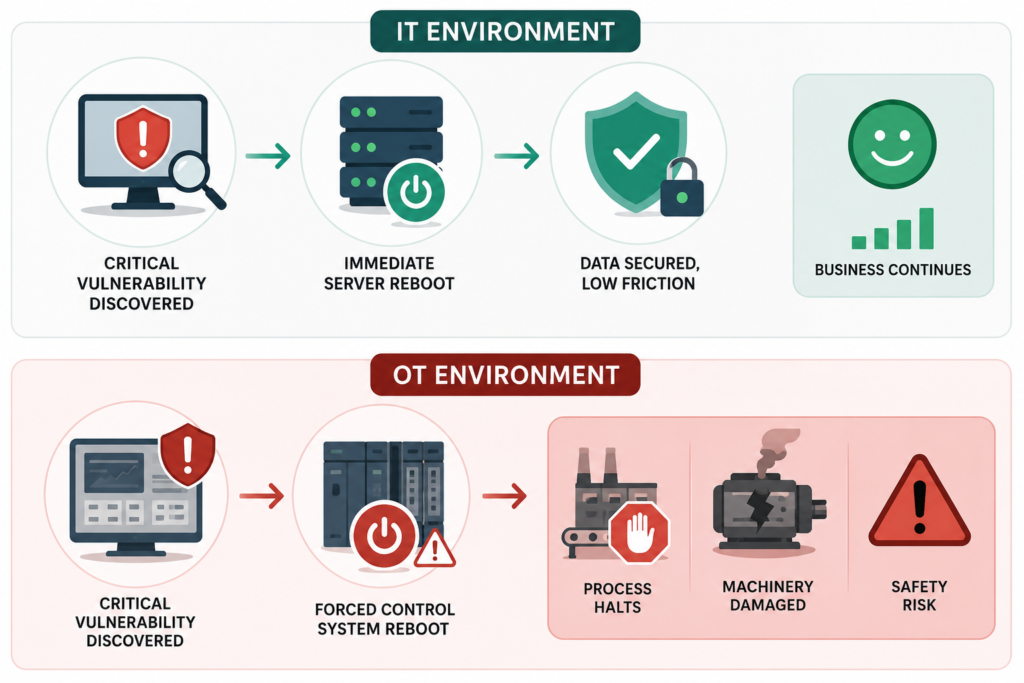
In an office building, an administrator can push an emergency security update and reboot a mail server at noon. Employees might experience a few minutes of frustration, but data remains safe, and operations quickly resume.
Doing that to a programmable logic controller managing a steel foundry or a chemical reactor could kill the cooling systems, halt a delicate chemical reaction mid-cycle, ruin millions in equipment, or trigger an explosion.
To appreciate why these environments require completely different defensive strategies, consider these core operational realities:
| Operational Dimension | Information Technology (IT) | Operational Technology (OT) |
| Primary Priority | Data privacy and confidentiality | Human safety and continuous process uptime |
| Asset Lifespan | Rapid refresh cycles every 3 to 5 years | Heavy machinery operational for 15 to 30 years |
| Patch Frequency | Weekly or monthly automated updates | Rare updates, often delayed for annual maintenance shutdowns |
| Protocols Used | Standardized web traffic like HTTP, TCP/IP | Proprietary industrial traffic like Modbus, Profinet, and DNP3 |
| Operating Conditions | Climate-controlled corporate data centers | Harsh, dusty, hot, or remote industrial field sites |
The Industrial Systems OT Security Protects
Defending an industrial site requires a deep understanding of specialized electronic components that don’t exist in standard corporate offices. These components translate digital commands into physical force.
Programmable Logic Controllers
Known across industries as PLCs, these ruggedized digital computers serve as the frontline brains of an industrial operation. They ingest data from physical sensors, process it based on custom programming, and instantly send output commands to mechanical components. They act as the precise controllers for high-speed electric motors, hydraulic pumps, fluid valves, heavy conveyors, and robotic assembly arms.
Supervisory Control and Data Acquisition Systems
Commonly abbreviated as SCADA, these expansive software platforms provide high-level, centralized monitoring and control over sprawling geographic footprints. Water utilities managing hundreds of miles of water mains, regional electric providers tracking substations, and energy companies running cross-country pipelines rely entirely on SCADA architectures to synthesize field data and transmit operator commands across massive distances.
Distributed Control Systems
A DCS manages large, highly complex industrial environments where processes happen continuously and require tight, synchronized loops. Unlike a single SCADA system monitoring remote sites, a DCS deploys a highly localized grid of interconnected controllers throughout a facility. This architecture is the backbone of chemical processing plants, oil refineries, and nuclear power generation stations.
Human-Machine Interfaces
HMIs are the visual dashboards, touchscreens, and control room monitors that allow human operators to see exactly what is happening inside a machine or pipeline. An HMI translates thousands of lines of raw sensor data into easy-to-read gauges, charts, and alarm systems, giving engineers the ability to tweak temperatures, adjust pressures, or shut down a failing line with a tap of a screen.
Sensors and Industrial Smart Devices
The foundational layer of modern automation consists of thousands of specialized, field-deployed sensors. These tiny devices continuously measure physical metrics like temperature shifts, pressure fluctuations, fluid flow rates, and minute structural vibrations. This continuous stream of real-world data feeds directly into PLCs, keeping the entire automated apparatus running within safe engineering parameters.
Real-World OT Security Incidents
The necessity of specialized industrial defense is not theoretical. A series of historic, highly disruptive cyberattacks proved that digital code can be weaponized to cause catastrophic physical destruction and societal chaos.
Stuxnet
The geopolitical landscape changed forever with the discovery of the Stuxnet malware. This highly sophisticated piece of code didn’t try to steal files or encrypt data for ransom. Instead, it silently infiltrated a specific industrial facility, bypassed safety monitors, and forced specialized gas centrifuges to spin at destructive speeds while feeding fake “normal” telemetry back to the control room screens. It proved that software could destroy heavy physical infrastructure without firing a single physical round.
Colonial Pipeline
In 2021, a devastating ransomware attack struck the corporate IT networks of the Colonial Pipeline company. Out of an abundance of caution, and because billing and operational tracking systems went dark, operators made the decision to manually shut down thousands of miles of fuel pipelines. Within days, gas stations across the southeastern United States ran completely dry, flight schedules stalled, fuel prices spiked, and the world witnessed how an IT breach can instantly cripple critical regional energy infrastructure.
Oldsmar Water Facility
A terrifying glimpse into municipal vulnerability occurred when a hacker compromised a remote access connection at the water treatment facility in Oldsmar, Florida. Once inside the system, the attacker took control of an operator’s terminal and attempted to increase the concentration of sodium hydroxide—commonly known as lye—in the water supply to highly dangerous levels. A vigilant operator watched the cursor move across his screen in real time and reversed the change before contaminated water could enter the public distribution grid, highlighting the immediate human safety risks of weak OT controls.
The Threats Modern OT Environments Face
The profile of attackers targeting industrial operations has shifted from casual curiosity to highly organized, well-funded operations with varying motivations.
- Ransomware Syndicates target industrial companies because they know every hour of downtime costs millions of dollars, creating massive financial leverage to force a quick payout.
- Nation-State Actors deploy advanced threat groups to quietly infiltrate foreign electrical grids, water systems, and transport hubs, leaving sleeper access points designed to disrupt infrastructure during future geopolitical conflicts.
- Supply Chain Attackers compromise smaller, less-secure third-party entities like HVAC contractors, engineering consultants, or industrial software vendors to sneak into a prime target’s core network through a trusted channel.
- Insider Threats involve disgruntled employees, poorly trained staff, or contractors who accidentally misconfigure a core controller or intentionally misuse their legitimate access to sabotage a production process.
- Remote Access Exploitation focuses on cracking weak, unmonitored remote connections used by maintenance teams, capturing valid credentials to bypass traditional firewall defenses entirely.
Standards That Shape Modern OT Security
Industrial operators do not have to invent their security strategies from scratch. Several rigorous, globally recognized frameworks provide detailed roadmaps for building resilient OT defenses.
ISA/IEC 62443
This stands as the absolute gold standard for industrial automation and control systems security. This flexible framework provides a comprehensive set of standards built for both asset owners and system integrators. It outlines how to segment an industrial facility into secure zones and conduits, ensuring that a breach in one minor system cannot spread to cause a facility-wide catastrophe.
NIST Special Publication 800-82
The National Institute of Standards and Technology provides this comprehensive security guide tailored specifically for Industrial Control Systems. The latest revisions offer detailed, practical advice on how to adapt traditional security controls like firewalls, logging, and access restrictions to the delicate, high-availability demands of modern OT environments.
NERC CIP
In North America, the North American Electric Reliability Corporation Critical Infrastructure Protection standards are strict, legally mandated regulations. Power generation companies and grid operators must comply with these rigid rules to protect the bulk power system from digital attacks, facing massive daily fines for failure to maintain audited cybersecurity baselines.
Where Operational Technology Security Is Headed
The evolution of industrial technology shows no signs of slowing down, forcing security strategies to adapt to a highly integrated, intelligent future.
The rise of smart manufacturing and the Industrial Internet of Things means thousands of new, internet-connected sensors are flooding factory floors every year. While these devices provide incredible process insights, they also dramatically expand the digital attack surface that security teams must monitor and defend.
Concurrently, artificial intelligence has entered the operational space, powering automated threat detection engines that can spot anomalous traffic patterns within complex industrial protocols long before a human analyst notices a variance.
The ultimate destination for forward-looking organizations is a converged security operations model. Companies are actively breaking down the traditional internal silos that separate IT security teams from physical plant engineers.
By feeding both corporate network logs and raw industrial process data into a single, unified monitoring center, organizations can finally establish a complete, real-world view of their cyber risk across the entire enterprise.
Frequently Asked Questions
What is operational technology security?
It is the specialized practice of defending the hardware, software, network protocols, and industrial control systems that monitor and manage physical machinery and automated processes across critical infrastructure, utilities, and manufacturing sectors.
Why is operational technology security important?
A security failure in an OT environment can trigger immediate real-world consequences, including catastrophic mechanical damage, long-term operational downtime, severe environmental contamination, and direct threats to public safety or human life.
What are the biggest threats to operational technology systems?
Modern OT systems are primary targets for sophisticated ransomware gangs seeking massive financial leverage, state-sponsored cyber units looking to compromise critical infrastructure, supply chain vulnerabilities, and poorly secured remote access pathways.
What challenges make operational technology security difficult?
Industrial environments frequently rely on legacy equipment designed decades ago without security in mind, require absolute continuous uptime that prevents standard software patching, and use highly specialized communication protocols that standard IT security tools cannot read.
How does operational technology security differ from traditional cybersecurity?
IT security focuses primarily on protecting data confidentiality and information privacy. OT security completely flips those priorities, placing human safety, operational availability, and physical process predictability above all other concerns.
What are the most effective ways to improve operational technology security?
Organizations must maintain complete visibility over all network assets, enforce strict network segmentation using zones and conduits, mandate multi-factor authentication on all remote access points, and continuously monitor industrial protocols for abnormal behavior.
Which industries depend most on operational technology security?
This discipline is absolutely vital for electrical generation and power grids, water treatment and distribution utilities, chemical processing facilities, oil and gas pipelines, heavy automotive and aerospace manufacturing, pharmaceutical production, and regional transportation networks.