

Operational technology cyber security has emerged as a cornerstone of modern industrial safety. For decades, industrial plants functioned in complete isolation from the digital world, relying on physical air gaps to remain secure. Today, the rapid integration of industrial machinery with corporate networks and cloud computing has transformed global supply chains while introducing unprecedented vulnerabilities.
Manufacturing plants, public power grids, oil refineries, and water treatment facilities utilize these connected systems to sustain economic output and community welfare. When an enterprise bridges the gap between office software and heavy machinery, a digital vulnerability can transform into a physical hazard. This fundamental shift makes securing operational systems a matter of national security and public safety.
Safeguarding these environments requires a deep intersection of industrial engineering, robust network architecture, and specialized threat intelligence. Understanding the underlying technologies, historical liabilities, and modern defensive frameworks is the first step toward securing the physical foundation of our society.
Understanding Operational Technology
Operational technology encompasses the specialized hardware and software configurations deployed to monitor, regulate, and automate physical machinery and real-world industrial processes. Unlike information technology, which processes data to support administrative business functions, this technology interacts directly with physical assets.
Industrial environments deploy these systems extensively across diverse infrastructure sectors:
- Electric Power Utilities: Controlling generation plants, high-voltage transmission grids, and localized distribution substations.
- Water Infrastructure: Managing high-capacity pumps, automated chemical dosing systems, and filtration networks.
- Energy Transport: Regulating cross-country oil pipelines, natural gas storage facilities, and compressor stations.
- Advanced Manufacturing: Coordinating robotic assembly lines, complex conveyor networks, and heavy industrial motors.
- Transportation Networks: Operating automated rail switches, maritime cargo systems, and signaling infrastructure.
In a practical setting, a failure in standard office software might delay an email or an invoice. In sharp contrast, an unmitigated error in an operational system can cause an industrial boiler to overheat, a valve to rupture, or an entire regional electrical grid to drop offline. The primary objective of this discipline is ensuring the safety, reliability, and continuous availability of physical operations.
Why Operational Technology Requires Specialized Cybersecurity
Industrial assets are built for extreme durability and long-term operational consistency rather than digital defense. It is common to find operational facilities running heavy machinery that has been in continuous service for 20 to 30 years. These legacy systems were engineered, tested, and installed long before modern internet-based cyber threats existed.
Historically, physical isolation protected these systems from external exploitation. Modern industrial demands have shattered this isolation, forcing organizations to connect plant floors directly to enterprise networks to achieve specific business outcomes:
- Predictive Maintenance: Streaming real-time vibration and heat data to vendors to predict machine failures before they occur.
- Remote Operational Support: Allowing off-site engineers to adjust system configurations through external networks.
- Supply Chain Optimization: Linking production output metrics directly with corporate resource planning databases.
This connectivity creates an expansive attack surface. When an attacker compromises an enterprise IT network, they often attempt to move laterally through internal gateways into the underlying engineering networks.
Because a successful intrusion can trigger physical destruction or prolonged service outages affecting millions of citizens, traditional security tools like aggressive automated vulnerability scanning or immediate software patching cannot be applied blindly without risking catastrophic operational failure.
Operational Technology vs. Information Technology
Though information systems and operational machinery are increasingly interconnected, they operate under entirely different priorities and technical constraints.
| Feature / Requirement | Operational Technology (OT) | Information Technology (IT) |
| Primary Objective | Controls physical machinery and real-world processes | Manages, stores, and transmits digital business data |
| Core Priority | Availability and Safety (The system must never stop running) | Confidentiality (Data must be shielded from unauthorized eyes) |
| Asset Lifecycle | Long lifecycles ranging from 15 to 30 years | Fast lifecycles with refreshes every 3 to 5 years |
| Update Protocols | Infrequent updates during rare, planned shutdown windows | Continuous, automated software patching and hotfixes |
| Network Protocols | Legacy industrial protocols missing basic encryption | Standard, highly secure internet and enterprise protocols |
| Consequence of Failure | Physical damage, environmental hazards, injury to life | Data breaches, intellectual property theft, financial losses |
In an office setting, a system administrator can reboot a mail server during the workday with minimal broader impact. In an industrial plant, unexpected downtime on a control server can stall an entire assembly line, ruin millions of dollars in chemical batches, or trigger emergency shutdown sequences that strain physical equipment. Consequently, defensive measures must prioritize operational uptime above all else.
The Building Blocks of Industrial Control Systems
Industrial Control Systems is the collective term for the integrated hardware and software architectures used to drive automation.
Supervisory Control and Data Acquisition (SCADA)
SCADA systems are designed to manage large, geographically dispersed infrastructure networks. A centralized SCADA platform aggregates operational data from hundreds of miles away, allowing operators to monitor statuses and send high-level commands to remote sites from a single control room. This architecture is vital for national power grids, regional water distribution networks, and cross-border oil pipelines.
Distributed Control Systems (DCS)
DCS configurations focus on high-performance control within a single, localized facility. Instead of relying on a single central controller, the intelligence is distributed throughout the plant across multiple localized subsystems. This architecture is standard in continuous-process industries like petroleum refining, pharmaceutical formulation, and chemical manufacturing, where minor deviations in temperature or pressure can ruin an entire production cycle.
Programmable Logic Controllers (PLCs)
PLCs are highly rugged, solid-state industrial computers designed to withstand extreme temperatures, severe vibration, dust, and electrical noise.
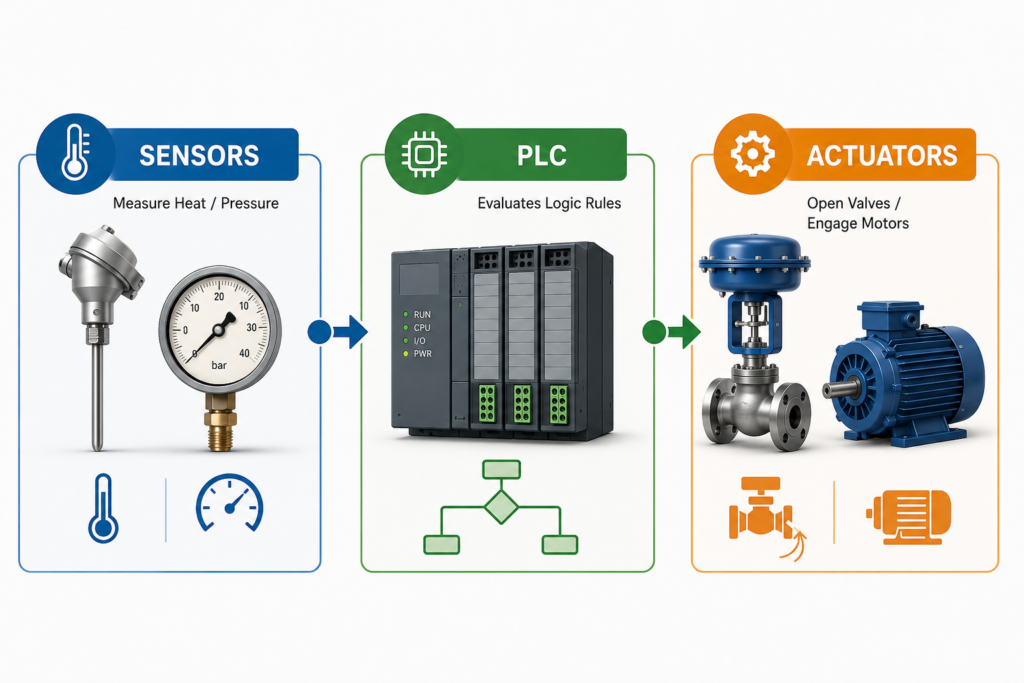
A PLC reads incoming digital or analog data from physical sensors, processes that data against a pre-programmed logic loop, and immediately fires commands to physical machinery on the shop floor.
Remote Terminal Units (RTUs)
RTUs are specialized electronic deployment units placed at remote geographical outposts, such as pipeline valve stations or remote electrical substations. These devices collect field telemetry data and convert it into digital formats suitable for transmission over long-distance radio, cellular, or satellite links back to a primary SCADA control center.
Human-Machine Interfaces (HMIs)
An HMI is a visual dashboard or digital terminal that presents real-time operational data to human operators.
These screens display active piping layouts, live temperature readouts, and critical system alarms. Operators use HMIs to visually track physical metrics, acknowledge automated system alerts, and manually intervene in operations when necessary.
Sensors and Actuators
Sensors and actuators serve as the physical hands and eyes of an industrial control network. Sensors continuously capture real-world conditions like flow velocity, liquid levels, and pressure. Actuators receive electronic commands from PLCs or human operators to execute a physical change, such as spinning an electric motor, closing a safety gate, or opening a physical fluid valve.
Industrial Communication Protocols
Industrial networks use specialized communication languages optimized for real-time control. Because many of these protocols were written decades ago for isolated networks, they lack modern security features like cryptographic authentication or data encryption.
- Modbus: Created in 1979, this simple, open protocol remains highly prevalent in factory automation. Because it sends data in plaintext without authentication, any device on the network can easily spoof commands to control machinery.
- DNP3: The Distributed Network Protocol is the standard language for the North American power grid and water utilities. While modern variations include secure authentication extensions, millions of older legacy deployments transmit raw telemetry and control commands without built-in encryption.
- OPC UA: The Open Platform Communications Unified Architecture is a modern, platform-independent standard designed to bridge the gap between IT and OT. It features robust, built-in security controls, including digital certificate exchange, user authentication, and end-to-end encryption.
- PROFINET: An advanced Industrial Ethernet standard used heavily in automated manufacturing plants. It allows high-speed, real-time data exchange between PLCs and field devices over standard network cabling.
- EtherNet/IP: This protocol adapts standard Ethernet infrastructure to industrial automation applications, allowing standard network hardware to transport real-time control data via the Common Industrial Protocol.
How Industrial Networks Are Organized
To protect sensitive industrial processes from external network threats, organizations organize their architectures into distinct, isolated layers. The definitive framework for this structure is the Purdue Enterprise Reference Architecture, universally known as the Purdue Model.
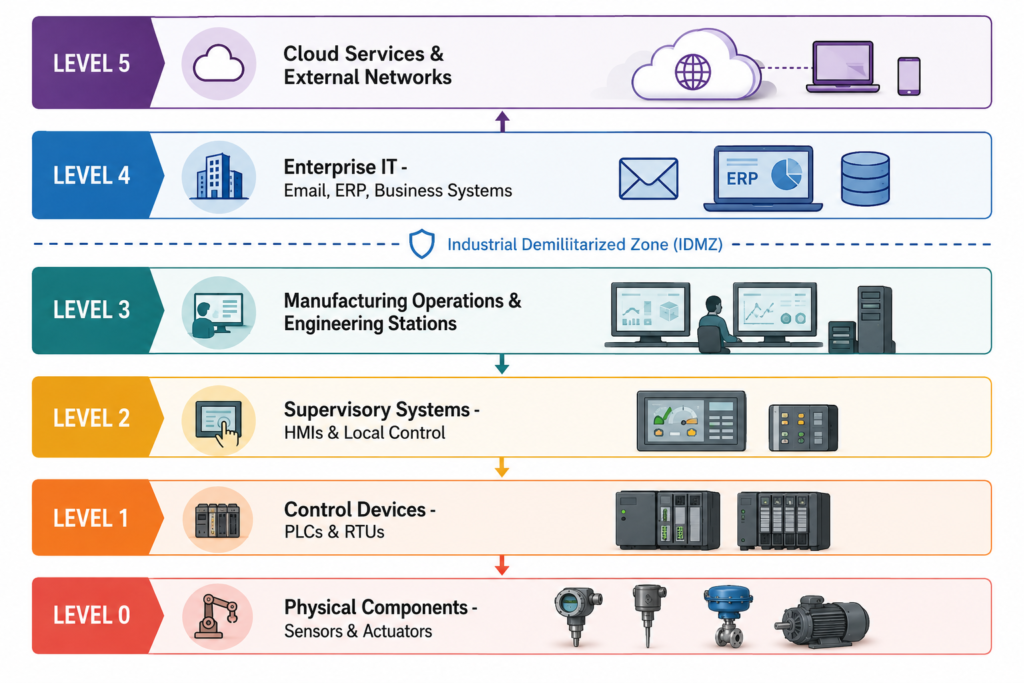
This structural division creates a highly controlled pipeline for data flow. Security professionals deploy an Industrial Demilitarized Zone containing strict firewall rules between Level 3 and Level 4. This ensures that an enterprise IT infection cannot breach the lower operational layers controlling physical processes.
Why Critical Infrastructure Depends on OT Security
Modern civil societies require uninterrupted access to electricity, clean water, and fuel to function safely. Because modern infrastructure is deeply interconnected, a severe failure in one sector quickly triggers cascading impacts across others.
A prolonged power grid blackout instantly paralyzes water treatment plants, halts regional rail systems, disrupts cellular communications, and forces hospitals onto emergency generator power. This structural fragility is why global regulatory bodies classify industrial security as a core national security priority.
Agencies like the Cybersecurity and Infrastructure Security Agency and the National Institute of Standards and Technology constantly publish actionable threat intelligence, joint security advisories, and updated architectural guidance to assist critical infrastructure operators in hardening their control networks against sophisticated adversaries.
How Cyber Threats Target Operational Technology
As industrial operations connect to enterprise software, cloud platforms, and third-party remote access portals, they face a broader array of digital threats. While IT attacks generally focus on data theft, extortion, or intellectual property monetization, malicious campaigns targeting operational environments are frequently designed to cause physical disruption, asset destruction, or geopolitical instability.
Legacy systems complicate these defense efforts. Many older PLCs running critical industrial tasks lack the processing power to handle modern encrypted communications, cannot run endpoint antivirus software, and run proprietary operating systems that cannot be patched without taking a facility completely offline. This presents a unique challenge where traditional defensive methods must be adapted to preserve operational uptime.
Common Attack Vectors
Threat actors exploit several recurring vulnerabilities to breach operational networks:
- Compromised Remote Access: Unsecured vendor VPNs, exposed Remote Desktop Protocol connections, and weak third-party maintenance portals provide direct paths into control systems.
- Enterprise Phishing Campaigns: Attackers breach an employee’s business email account at the IT layer, using that access to steal credentials and move laterally past internal firewalls.
- Supply Chain Exploits: Adversaries compromise upstream software updates, firmware packages, or third-party hardware components to slip past perimeter defenses.
- Unpatched Software Vulnerabilities: Exploiting publicly known vulnerabilities in older engineering workstations or HMI applications that cannot be easily updated due to production demands.
- Removable Storage Media: Rogue or infected USB drives brought directly onto the plant floor by well-meaning technicians or contractors bypassing network defenses.
- Flawed Network Segmentation: Improperly configured firewalls that allow direct, unfiltered communication between corporate office networks and physical control networks.
Lessons from Major Industrial Cyberattacks
Several historical security events show how digital attacks on operational technology can cause real-world damage and disrupt critical public services.
Stuxnet
Discovered in 2010, Stuxnet was a highly complex, targeted cyber weapon engineered to sabotage centrifuges at an enrichment facility in Iran. The malware exploited multiple zero-day vulnerabilities to silently alter the rotational speeds of specific PLCs, causing physical equipment failure while simultaneously feeding normal operational readouts back to the HMI screens to deceive operators. This incident proved that digital code could destroy physical infrastructure without a single explosion.
BlackEnergy
In 2015, malicious actors deployed the BlackEnergy malware family against regional electrical utilities in Ukraine. The intruders gained unauthorized access to internal control networks, opened circuit breakers across multiple substations, wiped system drives to delay recovery, and launched a phone flood attack against customer call centers to mask the disruption. The incident caused widespread blackouts that left over 225,000 citizens without electricity in freezing temperatures.
Industroyer (CrashOverride)
Returning to target Ukraine’s electrical infrastructure in 2016, adversaries deployed Industroyer, a highly sophisticated malware framework designed to speak industrial protocols natively. Instead of exploiting software flaws, the malware issued legitimate command protocols directly to electrical transmission substations, turning the grid’s normal operational functions against itself.
TRITON (Trisis)
In 2017, an attack targeted a petrochemical plant in Saudi Arabia using malware called TRITON. This framework directly targeted Safety Instrumented Systems—the dedicated safety controllers engineered to prevent catastrophic industrial accidents. By modifying the safety logic, the attackers attempted to disable emergency shutdown capabilities, creating a high-risk scenario capable of leading to physical explosions or toxic gas releases.
Colonial Pipeline
In 2021, a major ransomware attack targeted the corporate IT systems of the Colonial Pipeline Company. Although the ransomware did not breach the operational technology network directly, management proactively halted pipeline operations for several days out of caution and due to the loss of billing systems. This shutdown caused widespread fuel shortages, panic buying, and soaring fuel prices across the eastern United States, demonstrating how an IT breach can severely impact critical physical infrastructure.
Building a Strong Operational Technology Security Strategy
Protecting an industrial control environment requires a comprehensive defense-in-depth model that integrates technology, personnel training, and physical processes.
Maintain an Accurate Asset Inventory
An enterprise cannot secure assets it does not know exist. A comprehensive, real-time inventory must identify every PLC, RTU, HMI, engineering workstation, and connected sensor on the network. This includes cataloging exact hardware models, installed firmware levels, application versions, and communication profiles. Maintaining this granular visibility allows security teams to identify active vulnerabilities and quickly isolate unauthorized rogue devices.
Segment Industrial Networks
Rigorous network segmentation prevents an attacker from moving freely across systems. By implementing the Purdue Model, organizations insert rugged, industrial-grade firewalls between corporate business networks and the production environment.
All communications between these zones must terminate within an explicit Industrial Demilitarized Zone. No direct, unmonitored connections should ever link an office environment to a physical control network.
Secure Remote Access
While remote access allows for efficient off-site engineering support, it remains a high-risk entry point. Every external connection must pass through a centralized, secure access gateway located within the IDMZ. Organizations must enforce Multi-Factor Authentication, employ role-based access limits, establish time-bounded sessions, and record full video logs of all remote sessions to ensure accountability.
Apply Risk-Based Patch Management
Traditional IT patch cycles are impractical for continuous industrial processes. Organizations must adopt a risk-focused patching strategy that prioritizes vulnerabilities with known public exploits.
Updates should be thoroughly tested within an isolated staging lab before being deployed during planned maintenance windows. If a patch cannot be safely applied, teams must deploy compensating controls, such as specialized firewall rules or deep packet inspection signatures, to neutralize the threat.
Continuously Monitor OT Networks
Industrial operations rely on highly predictable, repetitive network traffic patterns.
By deploying passive, non-intrusive network monitoring solutions, security teams can analyze raw traffic down to the protocol layer. This allows them to instantly flag abnormal controller changes, unauthorized configuration commands, or unusual lateral communication shifts without disrupting sensitive physical systems.
Prepare an OT Incident Response Plan
When an active security incident occurs, standard IT response playbooks like automatically wiping systems or shutting down networks can inadvertently create physical safety hazards. An industrial incident response plan must prioritize physical safety and operational availability above all else.
The strategy must clearly define communication protocols between cybersecurity analysts and field automation engineers, outline manual override procedures for compromised systems, and establish validated backup recovery workflows to safely restore production.
Security Standards That Guide OT Protection
Industrial organizations rely on established, internationally recognized frameworks to design, audit, and mature their security postures.
- IEC 62443: This international standard provides a comprehensive framework for securing industrial automation and control systems. It covers secure product manufacturing, risk assessment methodologies, network zoning rules, and explicit technical security requirements for component vendors and facility operators alike.
- NIST SP 800-82: Published by the National Institute of Standards and Technology, this special publication offers tailored guidance on securing industrial control systems. It details common threats, reference architectures, and practical security controls optimized for manufacturing, water, and energy sectors.
- NIST Cybersecurity Framework (CSF): A flexible framework designed around five core pillars: Identify, Protect, Detect, Respond, and Recover. Industrial operators adapt these pillars to align corporate business governance with floor-level operational security.
- NERC CIP: The North American Electric Reliability Corporation Critical Infrastructure Protection standards are mandatory regulatory requirements for bulk power system operators. Non-compliance can result in substantial financial penalties, ensuring utility companies maintain rigorous security baselines.
Bottom Line
Operational technology is the silent engine of modern civilization, driving the automation that delivers clean water, stable electricity, transportation, and vital consumer goods. As these physical networks converge with internet-facing corporate ecosystems, cybersecurity can no longer be treated as an isolated office responsibility. Digital defense is now a core requirement for physical safety and operational resilience.
Building an effective defense program requires moving away from traditional, disruptive IT practices and adopting specialized strategies like deep network segmentation, continuous passive monitoring, and strict remote access controls. By embedding frameworks like IEC 62443 and NIST SP 800-82 into daily operations, industrial enterprises can confidently embrace digital innovation while safeguarding their physical assets, their workers, and the communities that depend on them.
Frequently Asked Questions
Is operational technology the same as industrial control systems?
No. Operational technology is an overarching category that includes all hardware and software used to control real-world physical equipment. Industrial Control Systems are a specific subset of this category, encompassing the specialized control systems like SCADA, DCS, and PLCs that actively drive industrial automation.
Why can’t industrial systems simply use traditional IT security?
Traditional IT security tools focus primarily on protecting data confidentiality through automated patches, heavy encryption, and active endpoint scans. In an operational environment, an uncoordinated automated scan or an unscheduled system reboot can crash a controller, halting physical operations and creating safety risks.
Which industries rely most on operational technology?
This technology is central to critical infrastructure, including electrical power generation, water treatment, oil and gas refining, chemical manufacturing, pharmaceutical production, mining operations, mass transit rail systems, and large-scale commercial manufacturing facilities.
What is the biggest cybersecurity risk for operational technology?
The most significant risks include weak network segmentation that allows malware to cross over from corporate networks, unsecured remote access portals used by third-party technicians, and legacy field devices running outdated protocols that lack built-in security or authentication.
Can small manufacturers benefit from OT cybersecurity?
Yes. Modern cyber threats like automated ransomware campaigns rarely distinguish between small businesses and global corporations. Because smaller manufacturing operations often lack dedicated security teams, they can be highly vulnerable targets. Implementing basic hygiene like network segmentation and secure remote access provides significant protection.