

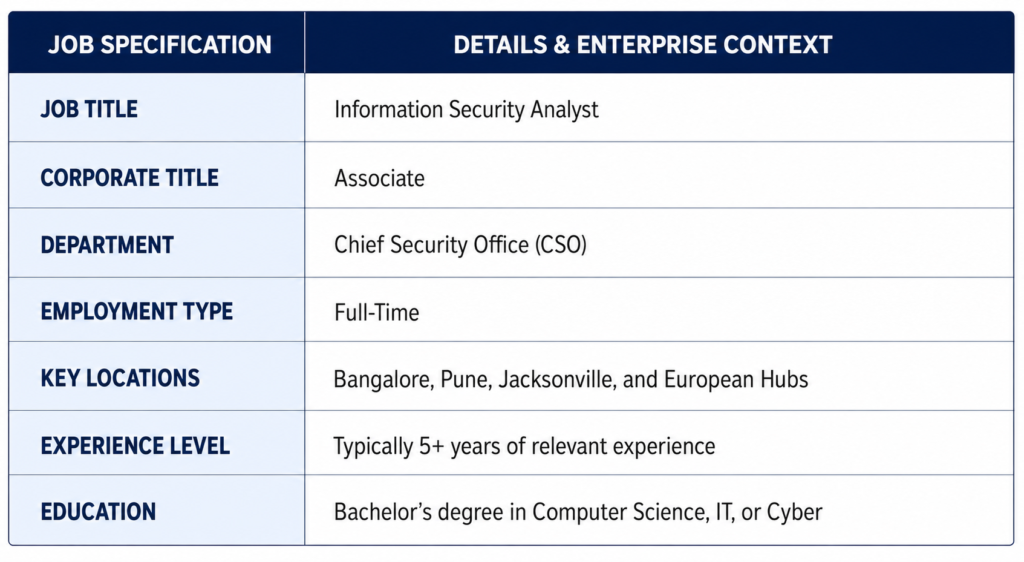
Securing an Information Security Analyst – Associate position at Deutsche Bank requires recognizing that this title represents a spectrum of specialized careers rather than a single, static job function. Deutsche Bank actively recruits technology professionals to fill these associate roles across diverse global hubs. These professionals sit directly within the Chief Security Office, an enterprise-wide division tasked with shielding one of the most complex financial institutions in the world.
The bank distributes these analysts across multiple dedicated security disciplines to ensure a defense-in-depth posture. An analyst assigned to one team may focus purely on governance, while another in the same location might spend their day building cloud architecture safeguards or analyzing active data logs.
Despite these distinct day-to-day operations, every analyst shares a foundational core mission. The ultimate goal is to safeguard the bank’s highly sensitive corporate infrastructure, financial transactional data, and international client portals while maintaining strict alignment with internal security policies and stringent global financial regulations.
About Deutsche Bank
Deutsche Bank AG stands as a pillar of global finance, operating its primary headquarters from Frankfurt, Germany. The institution serves as a critical engine for international commerce, providing complex investment banking services, corporate banking solutions, sophisticated asset management platforms, and private banking channels to corporations, sovereign governments, and institutional investors globally.
Operating at this scale means the bank handles massive financial volumes and sensitive data flows every second. Consequently, cybersecurity functions as a core business driver rather than a secondary support system. The Chief Security Office centralizes the bank’s defensive strategies, deploying advanced methodologies across network engineering, threat management, identity governance, and insider threat mitigation to protect physical and digital assets worldwide.
Job Overview
Specialized Functional Areas
The associate corporate title indicates that professionals are expected to bring prior domain experience, operating above entry-level expectations. The dynamic nature of the Chief Security Office means an associate will be aligned with one of these key pillars:
- Information Security Risk: Focuses heavily on identifying application vulnerabilities, conducting system threat modeling, and evaluating corporate risk postures.
- Identity & Access Management: Specializes in user lifecycle management, directory architecture, and enforce privilege structures across bank software.
- Information Security Operations: Centers on active monitoring, security information event management platforms, and incident triage.
- Security Engineering and Cryptography: Involves structural architecture development, certificate management lifecycle, and hard deployment configurations.
- Cloud and Insider Risk: Targets threat mitigation within hyper-scaler environments and monitors for data exfiltration patterns inside the corporate network.
Analysts do not operate in silos but act as internal security consultants. Daily operations necessitate collaboration with Information Security Officers, IT Application Owners, infrastructure engineers, regulatory compliance teams, and external auditors to guarantee that security controls remain robust and functional.
Key Responsibilities
Strategic Support and Framework Implementation
Associates directly contribute to operationalizing the overarching security strategy designed by the Chief Security Office. They translate high-level security frameworks into daily operational checks, ensuring that defensive mechanisms adapt to shifting external threat vectors. Analysts are also responsible for identifying gaps within operational workflows and drafting process improvements to elevate defensive capabilities.
Comprehensive Security Risk Assessments
A major portion of the analyst workload involves assessing internal and third-party software applications. This requires analyzing the Confidentiality, Integrity, and Availability ratings of enterprise platforms. Analysts systematically dissect applications to uncover architectural vulnerabilities, document potential business impacts, and formulate clear remediation pathways for development teams.
Continuous Control Validation
Existing security controls must undergo continuous validation to remain effective. Analysts audit infrastructure configurations, cloud environments, and logical access parameters to verify that security baselines are maintained. These evaluations form the foundational evidence used to demonstrate adherence to both internal corporate policies and international banking laws.
Risk Lifecycle Tracking and Metrics
When threat gaps or vulnerabilities are identified, associates manage the tracking lifecycle from initial discovery to formal closure. They actively monitor security exceptions and track remediation progress against corporate deadlines. They compile these metrics into operational risk registers, giving management visibility into the bank’s real-time security posture.
Deep-Dive Investigation of Security Findings
When automated scanners or external audits flag compliance issues, the associate investigates the root causes. They gather technical artifacts, validate whether the issue presents a true risk, and guide application developers through remediation steps. If an identified vulnerability presents an immediate, unacceptable risk to bank operations, the analyst manages the internal escalation pathway to alert senior leadership.
Identity and Access Management Governance
Within identity-focused teams, associates oversee the onboarding of applications into centralized governance tools. They manage the complex rules surrounding Segregation of Duties to prevent conflicts of interest within financial software. Analysts also coordinate periodic access recertification campaigns and audit provisioning logs to ensure minimum privilege enforcement.
Active Security Operations and Event Triage
For those aligned with operations teams, the primary focus centers on analyzing security alerts generated by enterprise log collectors. Associates evaluate incoming events, differentiate between false positives and genuine security incidents, and initiate standard response plays. They handle early-stage containment activities and hand off high-priority incidents to dedicated forensic teams.
Engineering, Automation, and Pipeline Security
Analysts working in engineering environments leverage automation to eliminate repetitive operational tasks. They build script components to streamline control testing and assist in integrating security tooling directly into developer pipelines. They also help manage internal cryptographic keys and validate infrastructure configurations prior to production deployment.
Evidence Collection, Documentation, and Audit Readiness
Regulatory scrutiny requires meticulous record-keeping. Associates maintain detailed operational handbooks, author comprehensive risk assessment reports, and curate evidence files for regulatory bodies. When internal or external auditors submit requests, the analyst ensures that data extracts are complete, accurate, and delivered promptly.
Stakeholder Collaboration Across Global Teams
Because Deutsche Bank operates a cross-border business model, associates spend considerable time communicating with diverse internal business units. They explain technical vulnerabilities to non-technical business managers, align remediation schedules with project managers, and coordinate security deployments alongside engineering leads.
Required Qualifications
Educational Background and Professional Tenure
Securing this corporate associate title requires a solid foundational background in technical disciplines. Candidates generally must possess a formal Bachelor’s degree from an accredited institution focused on Computer Science, Information Technology, Cybersecurity, or systemic Engineering fields.
In addition to academic qualifications, candidates typically need around five years of direct professional experience within a cybersecurity infrastructure role, data governance ecosystem, or enterprise risk management environment. This experience requirement ensures that associates can hit the ground running without requiring fundamental training.
Analytical Capabilities and Core Competencies
The role demands strong analytical capabilities to trace complex systemic issues back to their origin points. Candidates must possess the communication skills required to author detailed technical risk papers and clearly convey security concepts in English, which serves as the bank’s primary global business language. Experience navigating the heavy compliance frameworks common to global banking or highly regulated environments provides candidates with a distinct competitive advantage during selection.
Technical Skills
Core Architecture and Cybersecurity Principles
A strong candidate must demonstrate a deep understanding of core information security structures, including identity governance, security architecture, data protection laws, and risk frameworks. They must be comfortable evaluating network structures and checking foundational elements like TCP/IP configurations, DNS resolution parameters, and HTTP/HTTPS protocols. Analysts also regularly interact with major server operating environments, including both Windows and Linux distributions, alongside enterprise database architectures.
Modern Cloud Architecture and Infrastructure
As the banking sector shifts workloads to modernized environments, knowledge of cloud infrastructure has become increasingly important. Many teams require functional literacy in cloud platforms like Google Cloud Platform, Microsoft Azure, or Amazon Web Services.
Familiarity with containerized application deployments via Docker and orchestration through Kubernetes is highly valued. Understanding how infrastructure can be deployed programmatically using tools like Terraform within continuous integration pipelines is also a significant differentiator.
Programming, Scripting, and Automation Languages
For positions tied to security engineering, automation, or cryptography, data analysis skills are essential. Candidates benefit from working knowledge of programming and scripting options:
- Python: Used extensively for automating security testing and parsing large log sets.
- Java: Highly useful for analyzing internal application vulnerabilities and reviewing secure code.
- SQL: Necessary for querying security information stores and access repositories.
- Visual Basic: Frequently utilized within compliance teams to optimize legacy reporting pipelines.
Familiarity with code repository management frameworks like Git or Bitbucket is also expected for automation-focused roles.
Alignment With Industry Frameworks and Standards
Deutsche Bank structures its defensive postures around established international benchmarks. Analysts are expected to understand and apply components from recognized frameworks, including ISO/IEC 27001, the NIST Cybersecurity Framework, COBIT, ITIL, the Cloud Security Alliance Cloud Controls Matrix, and the MITRE ATT&CK matrix for analyzing threat actor behaviors.
Preferred Certifications
While a resume can be competitive without them, holding recognized industry certifications helps validate your technical knowledge during the application process. The bank frequently targets specific credentials based on team alignment:
- Enterprise Security Management: Certified Information Systems Security Professional (CISSP) or Certified Information Security Manager (CISM).
- Audit and Systems Control: Certified Information Systems Auditor (CISA) or Certified in Risk and Information Systems Control (CRISC).
- Technical Fundamentals and Operations: CompTIA Security+ or the GIAC Certified Incident Handler (GCIH).
- Process Verification: Formal ISO/IEC 27001 Lead Auditor credentials.
Tools and Technologies
Operating inside the bank’s defensive architecture involves working with an advanced software suite. Analysts interact with enterprise logging platforms like Splunk and Microsoft Sentinel to track security events. Threat monitoring and compliance tracking are maintained using systems such as Microsoft Defender, Microsoft Purview, and DTEX user behavior analytics. Engineering analysts focus on configuration management tools like Terraform, code repositories such as Git and Bitbucket, and container deployment environments utilizing Docker and Kubernetes.
Employee Benefits
Deutsche Bank provides competitive total compensation packages designed to support long-term career growth and personal well-being. While specific benefits vary depending on regional employment laws, the bank’s core offerings regularly feature:
- Time Off: Competitive annual leave allocations alongside gender-neutral parental leave programs.
- Family Support: Targeted childcare assistance programs and reimbursement options where locally applicable.
- Career Advancement: Financial sponsorship for professional certifications, educational advancements, and continuous training platforms.
- Health and Wellness: Comprehensive medical insurance, accidental coverage, life insurance protection, and preventative health checks.
- Support Systems: Access to the global Employee Assistance Program for mental and emotional well-being, coupled with modern hybrid work options tailored to specific team requirements.
Is This Job Still Available?
The Information Security Analyst – Associate role is not a single requisition that remains open indefinitely. Instead, Deutsche Bank opens and closes specific openings throughout the year to align with headcount needs, organizational restructures, and regional project timelines.
While certain previously advertised openings across tech hubs like Bangalore, Pune, and Jacksonville may close once filled, new opportunities within identity management, risk assessment, and security engineering regularly open up. Candidates should routinely monitor the bank’s recruitment listings to catch new postings early.
How to Apply
Applying for an open position requires navigating through the bank’s official channels:
- Access the official Deutsche Bank Careers portal directly.
- Input targeted search strings like Information Security Analyst, Associate Information Security, or Chief Security Office into the portal search tool.
- Filter results by your target geographic locations and open requirements.
- Carefully read the specific job description to identify which sub-team is hiring.
- Align your resume to highlight the specific technical skills and tools requested in that posting.
- Submit your formal application alongside your professional resume.
If your profile matches the team’s needs, you will enter the formal selection process. This involves initial human resources screening conversations, in-depth technical interviews with senior engineers, situational management evaluations, and a thorough global background check before a formal offer can be extended.
Final Thoughts
The Information Security Analyst – Associate position offers a career pathway within a top-tier financial institution’s defense network. By placing talent across crucial pillars like risk assessment, cloud architecture, governance, and active threat monitoring, the bank maintains a resilient posture against an evolving threat landscape.
Because the job expectations change based on which sub-team is hiring, successful applicants must review specific job descriptions carefully. Tailoring your application to highlight relevant experience in areas like automated scripting, identity architecture, or control testing will help you stand out as a strong candidate for these global roles.
Frequently Asked Questions
Is the Information Security Analyst – Associate position considered an entry-level job?
No. The corporate title of Associate at Deutsche Bank indicates that the position requires professional maturity. Most teams look for roughly five years of experience within IT, risk mitigation, governance, or active threat defense fields to ensure candidates can handle enterprise-scale responsibilities.
Do all associates holding this title perform the same daily activities?
No. The title serves as an umbrella category across the Chief Security Office. Your day-to-day tasks depend entirely on whether you are placed into risk management, identity governance, active security operations, engineering, or cryptography teams.
Must I know how to program to qualify for this role?
Not necessarily. Governance, risk, and compliance positions focus more on analytical control verification, requiring only basic scripting or reporting knowledge. Conversely, teams focused on infrastructure engineering and cryptography require strong programming skills in languages like Python or Java.
Which certification provides the absolute highest advantage?
There is no single best credential, as value depends on the team’s focus. For operational management and architecture, the CISSP is highly valued. For risk management and compliance, credentials like the CRISC or CISA are preferred.
What is the safest platform to use when submitting my application?
Applications should only be submitted directly through the official Deutsche Bank Careers portal. This ensures your personal information is processed securely and reaches the correct internal recruiting teams.