
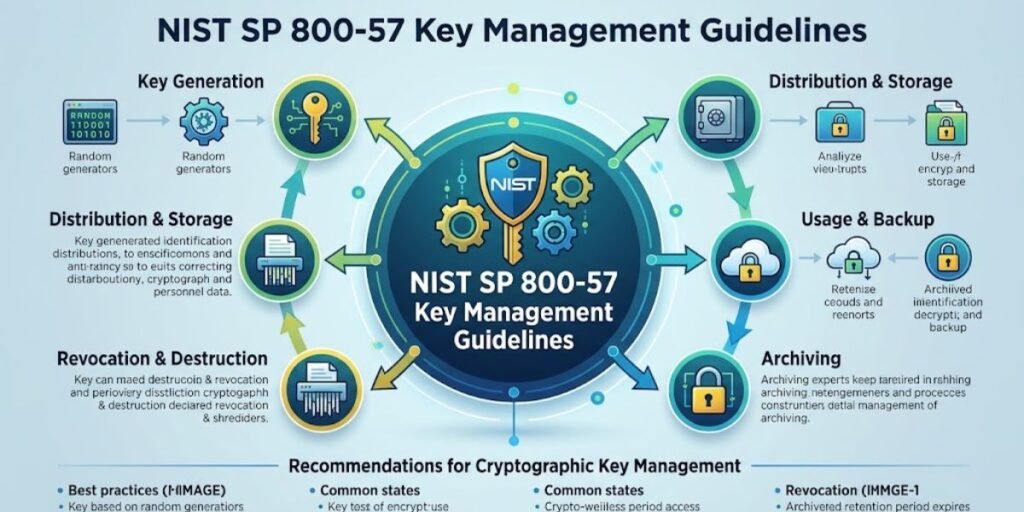
Information security relies heavily on robust encryption to protect sensitive data at rest, in transit, and during execution. Encryption algorithms operate as mathematical constructs designed to transform readable plaintext into unintelligible ciphertext. However, encryption alone cannot secure organizational assets when cryptographic keys are poorly generated, exposed through weak channels, improperly distributed, or retained long past their operational lifespan. A single compromised key can unravel an entire enterprise security architecture regardless of whether the system utilizes advanced AES-256 or RSA-4096 algorithms.
NIST Special Publication 800-57 serves as the definitive reference manual for managing cryptographic keys throughout their complete operational lifecycle. Published by the National Institute of Standards and Technology, this comprehensive multi-part publication provides structured recommendations for federal agencies, defense contractors, and commercial organizations striving to safeguard sensitive digital assets.
Security professionals must look beyond basic algorithm selection and focus on the systemic administration of key material. Readers will explore the core principles of key management, structural lifecycle phases, cryptoperiod calculations, compromise response strategies, and organizational governance structures required to build resilient, audit-ready cryptographic security programs.
What Is NIST SP 800-57?
NIST SP 800-57 is a foundational guideline established by the National Institute of Standards and Technology to standardize the management of cryptographic keys and key material. The publication addresses a core security reality: the security of a cryptographic mechanism depends almost entirely on the security of the underlying keys, the secrecy of private and secret key material, and the integrity of public keys.
Cryptographic systems deliver four fundamental security services across modern digital networks:
- Confidentiality: Ensuring that unauthorized individuals cannot inspect transmitted or stored information.
- Integrity: Verifying that data has not been altered, inserted, or deleted by unauthorized parties.
- Authentication: Confirming the identity of communicating entities or the source of specific data payloads.
- Non-Repudiation: Providing cryptographic proof that a specific transaction or signature originated from a designated entity.
A critical technical distinction exists between cryptographic algorithms and cryptographic keys. An algorithm is a published, mathematically deterministic function accessible to the public domain. The key represents the secret parameter fed into the algorithm to customize its output. When an algorithm is held static, system security depends entirely on preventing key exposure and maintaining proper lifecycle controls.
NIST SP 800-57 is designed for enterprise security architects, chief information security officers, systems engineers, compliance auditors, and software developers building encrypted applications. While SP 800-57 provides authoritative technical recommendations, it functions as a guidelines framework rather than a standalone mandatory statute, though its provisions are often rendered compulsory through federal mandates such as FISMA or specific commercial standards like PCI-DSS.
Understanding the Three Parts of NIST SP 800-57
NIST structures SP 800-57 into three complementary publications that collectively address the technical, administrative, and application-specific dimensions of key management. Organizations must implement all three components to maintain a compliant cryptographic posture.
Part 1: General Key Management Recommendations
Part 1 establishes the technical baseline for key management across all federal and enterprise systems. It defines cryptographic key types, security strengths, random number generation standards, distribution mechanics, storage requirements, lifecycle states, and cryptoperiod calculations. It provides the core theoretical framework required to prevent key compromise.
Part 2: Best Practices for Key Management Organizations
Part 2 shifts focus from raw technical specifications to organizational governance and administrative planning. It outlines how enterprises must structure key management infrastructures, establish formal Key Management Policies, draft operational Key Management Practice Statements, and assign explicit custodian responsibilities across centralized or decentralized environments.
Part 3: Application-Specific Key Management Guidance
Part 3 provides tailored key management recommendations for specific broad application contexts, such as Public Key Infrastructure deployment, IPsec implementation, Transport Layer Security setup, and storage encryption schemes. It demonstrates how general Part 1 principles translate into operational rules within concrete technology stacks.
Cryptographic Key Types and Their Security Requirements
Modern enterprise systems deploy diverse key architectures to fulfill distinct security functions. NIST SP 800-57 categorizes these keys based on their algorithmic structures, operational roles, and confidentiality needs.
Operational implementations rely on specific key types engineered for dedicated security functions:
- Symmetric Keys: Single secret keys shared between communicating entities used for both encryption and decryption. Symmetric keys demand strict confidentiality controls during distribution and storage.
- Asymmetric Key Pairs: Mathematically linked public and private keys used in public-key cryptography.
- Private Keys: The confidential component of an asymmetric pair. Private keys require high-grade physical and logical protection to prevent unauthorized signature generation or data decryption.
- Public Keys: The non-secret component of an asymmetric pair. Public keys require integrity protection and certificate validation to prevent unauthorized substitution or tampering.
- Key-Encryption Keys (KEKs): Symmetric keys dedicated exclusively to encrypting, wrapping, and protecting other keys during storage or transmission, preventing raw keys from residing in plaintext memory.
- Key-Derivation Keys (KDKs): High-entropy secret keys utilized alongside pseudorandom functions to derive multiple operational keys from a single master secret.
For instance, an enterprise database system might utilize a symmetric Data Encryption Key to encrypt stored customer records, while protecting that Data Encryption Key under a master Key-Encryption Key stored securely inside a dedicated Hardware Security Module.
The Cryptographic Key Lifecycle Under NIST SP 800-57
Lifecycle governance represents the core technical discipline within NIST SP 800-57 Part 1 Section 8. Managing keys through distinct, controlled states ensures that key material is never exposed prematurely or retained past its secure operational utility.
The diagram above illustrates the formal state transitions a key undergoes from generation through destruction:
Pre-operational Phase
Keys are created, registered, and prepared for future deployment. Key generation must utilize approved random number generators operating with sufficient entropy. During registration, the key is permanently linked with metadata specifying its unique identifier, algorithm type, authorized owner, intended purpose, and cryptoperiod bounds.
Operational Phase
Keys are actively deployed to perform intended cryptographic functions, such as encrypting active database transactions or signing digital certificates. During this phase, key management systems must enforce strict access controls, continuously audit administrative usage, and monitor key age relative to established rotation limits.
Post-operational Phase
Keys are deactivated and no longer permitted to process new operational data. However, post-operational keys are retained in secure storage or archives if they are still required to decrypt legacy data files or verify historic digital signatures generated during their active operational window.
Destroyed Phase
When a key reaches the end of its post-operational retention window, or if a severe security compromise occurs, the key material must be permanently destroyed. Destruction requires overwriting memory locations using zeroization methods, degaussing magnetic media, or physically destroying security hardware chips. Key metadata is retained separately for forensic audit trails.
Consider a practical financial signing scenario: an asymmetric private signing key is generated inside an HSM during the pre-operational phase, activated for a 12-month operational signing period, deactivated and moved to post-operational archival to verify old audit logs, and finally zeroized permanently during the destroyed phase five years later.
NIST Recommendations for Generating, Distributing, and Storing Cryptographic Keys
The security strength of a cryptographic deployment depends entirely on operational controls applied to key generation, transport, storage, and access governance. Implementing weak generation algorithms or unencrypted key storage voids the protective capabilities of underlying ciphers.
Generating key material requires cryptographically secure random number generators (RNGs) operating with sufficient entropy. Systems must utilize deterministic random bit generators (DRBGs) or non-deterministic random bit generators (NRBGs) compliant with NIST SP 800-90A, 800-90B, and 800-90C. Using predictable pseudo-random seeds introduces catastrophic vulnerabilities that leave keys exposed to mathematical reconstruction.
Distributing cryptographic keys across network boundaries demands secure key establishment protocols. Symmetric keys must be wrapped using key-encryption keys (KEKs) prior to transport or negotiated using authenticated key-agreement protocols such as Diffie-Hellman variants. Asymmetric public keys require digital signatures and certificate chain validation to confirm identity and prevent unauthorized substitution during transit.
Storing operational key material requires dedicated, tamper-resistant environments:
- Hardware Security Modules (HSMs): Dedicated cryptographic processors designed to generate, store, and manage keys inside validated physical protection boundaries compliant with FIPS 140-3 standards.
- Cryptographic Modules: Software or hardware boundaries that enforce logical access limits, zeroize memory upon tampering, and isolate plaintext key material from general operating system memory.
- Key Wrappers: Encrypting resting data encryption keys using master key-encryption keys before writing them to persistent storage repositories.
Backing up cryptographic keys is necessary to prevent permanent data loss in the event of hardware failure, but duplicate copies introduce additional exposure vectors. Backup keys must receive identical or superior security protections compared to active operational keys, utilizing encrypted storage vaults, split-knowledge secret sharing schemes, or dual-custody access controls.
Maintaining a comprehensive key inventory is essential for operational governance. Organizations must catalog key identifiers, algorithmic types, authorized owners, cryptoperiod expiration dates, associated system components, and operational status. Access controls must enforce strict role-based authorization and separation of duties, ensuring no single individual maintains sole capability to extract or utilize raw key material without independent authorization.
Cryptoperiods: How Long Should Cryptographic Keys Remain in Use?
A cryptoperiod is the defined time span during which a specific cryptographic key is authorized for operational use by active systems. Setting appropriate cryptoperiods limits the volume of data protected by a single key, reduces the window of vulnerability if a key is compromised, and constrains the time available for cryptanalytic attacks.
NIST SP 800-57 establishes a critical distinction between usage periods:
- Originator-Usage Period (OUP): The specific time window during which a key can be actively used to apply cryptographic protection, such as encrypting new data or generating new digital signatures.
- Recipient-Usage Period (RUP): The time frame during which a key may be used to process previously protected information, such as decrypting archived data or verifying historic digital signatures.
The recipient-usage period typically extends far beyond the originator-usage period. For example, a symmetric data encryption key might maintain a 1-year originator-usage period for writing new database records, but require a 10-year recipient-usage period to allow authorized systems to read historical archives.
Evaluating appropriate cryptoperiod lengths requires analyzing specific operational risk factors:
- Algorithm Strength and Key Length: Shorter key lengths or older algorithms require shorter cryptoperiods due to advancing computational attack capabilities.
- Volume of Protected Data: Encrypting massive datasets with a single symmetric key increases the exposure payload available to cryptanalysts, necessitating faster rotation schedules.
- Storage Environment Security: Keys stored in software memory require shorter usage windows than keys shielded inside FIPS 140-3 Level 3 hardware security modules.
- Operational Exposure Risk: Publicly accessible systems facing continuous internet exposure require tighter key rotation cycles than isolated internal infrastructure.
Establishing an automatic key rotation policy replaces static security setups with continuous key replacement schedules. Organizations must avoid applying a single, arbitrary rotation timeline across all key types. A symmetric key protecting transient API tokens might rotate daily, whereas a root certificate authority public key pair might maintain an operational cryptoperiod extending several years.
Protecting Cryptographic Keys Against Compromise
Protecting key material against unauthorized disclosure, alteration, or substitution requires multi-layered technical and administrative safeguards. A key compromise occurs when the secrecy of a private or secret key is breached, or when the integrity of a public key is altered by malicious actors.
Implementing effective protective measures requires enforcing fundamental access controls:
- Restricting plaintext key access to validated cryptographic modules and dedicated hardware environments.
- Enforcing role-based access controls (RBAC) alongside dual-authorization controls, requiring two independent custodians to authorize administrative key extraction or recovery.
- Shielding key metadata, certificates, and access logs from unauthorized inspection, preventing attackers from targeting high-value infrastructure assets.
- Auditing administrative key access operations continuously to detect unexpected export requests or policy modifications in real time.
- Conducting periodic reviews of active key inventories, administrative privileges, and custodian permissions to prune stale access rights.
Protecting key metadata is as critical as protecting the raw key values. If an attacker inspects metadata revealing which master key encrypts financial databases or active authentication services, they can tailor targeted intrusion vectors against specific key management nodes.
What Organizations Should Do When a Cryptographic Key Is Compromised
A cryptographic key compromise invalidates the trust foundation of affected systems. When unauthorized parties gain access to secret or private key material, organizations must execute a documented compromise-recovery plan immediately.
When a key compromise is confirmed or suspected, organizations must execute structured remediation steps:
- Immediate Revocation: Deactivate the compromised key immediately to halt all active originator-usage operations. If the key involves asymmetric public key infrastructure, publish a Certificate Revocation List (CRL) update or update Online Certificate Status Protocol (OCSP) responders.
- Key Replacement: Generate new, uncompromised key pairs or symmetric secret keys using verified random bit generators inside secure modules.
- Forensic Impact Analysis: Identify all data payloads encrypted, signed, or authenticated by the compromised key during its potential breach window.
- Data Remediation: Re-encrypt historical data payloads using newly established keys and re-issue digital signatures where historical integrity must be maintained.
- Incident Documentation: Document the breach timeline, root causes, technical impact, and corrective actions within formal incident response reports.
For instance, if an enterprise SSH private signing key used for automated administrative server deployment is exposed on a public code repository, administrators must immediately revoke the compromised public key across all server configurations, audit systems for unauthorized access logs, generate new key pairs inside an HSM, and update access credentials across deployment environments.
Key Management Policies and Organizational Responsibilities
NIST SP 800-57 Part 2 emphasizes that key management cannot remain solely an IT operational task. Establishing an enterprise key management program requires formal governance policies, documented procedures, and clear operational ownership across organizational roles.
Organizations must establish two foundational administrative documents:
- Key Management Policy: A high-level organizational mandate defining overall security objectives, authorized cryptographic algorithms, minimum key lengths, cryptoperiod boundaries, and compliance constraints.
- Key Management Practice Statement (KMPS): A detailed operational document specifying how the organization implements its Key Management Policy across actual hardware systems, application workflows, and personnel duties.
Distributing key management responsibilities requires assigning explicit operational roles:
- Security Leadership (CISO): Approves high-level key management policies and ensures alignment with enterprise risk management frameworks.
- System Owners: Define specific data protection requirements and approve operational cryptoperiods for business applications.
- Key Custodians: Manage day-to-day key generation, distribution, backup, and destruction procedures inside secure storage facilities.
- Auditors and Compliance Officers: Conduct independent evaluations of key inventories, access logs, and adherence to Key Management Practice Statements.
Organizations can deploy centralized key management architectures—utilizing unified enterprise key vaults and HSM clusters—or decentralized structures where business units manage dedicated key infrastructures under common governance policies. Centralization improves policy enforcement and auditing visibility, whereas decentralization accommodates diverse operational environments across global sub-entities.
Applying NIST SP 800-57 in Cloud and Enterprise Environments
Translating NIST key management recommendations into modern IT architectures requires applying core principles across diverse technical infrastructures.
Cloud Infrastructure and Key Management Services (KMS)
Cloud platforms provide managed Key Management Services (KMS) that automate key generation, storage, envelope encryption, and access logging. Under the shared responsibility model, cloud providers secure the underlying hardware modules (HSMs), while enterprise customers remain responsible for defining key access policies, setting cryptoperiod rotation rules, monitoring usage logs, and managing key ownership permissions.
Hardware Security Modules (HSMs)
Dedicated HSMs provide physical and logical protection for critical cryptographic roots of trust. Hardware security modules protect master keys against side-channel analysis, physical probing, and unauthorized extraction, executing cryptographic signing and key-wrapping operations entirely within validated tamper-evident boundaries.
Database and Storage Encryption
Database encryption schemes utilize envelope encryption architectures. Transparent Data Encryption (TDE) engines encrypt database files on disk using symmetric Data Encryption Keys (DEKs). These DEKs are wrapped and protected by a master Key-Encryption Key (KEK) managed separately within an external KMS or HSM, ensuring that stolen database files cannot be decrypted without external key access.
Public Key Infrastructure (PKI)
Enterprise PKI implementations rely on strict key management to validate identities across users, devices, and applications. Root Certificate Authority (CA) private keys represent the highest value asset within a PKI, requiring complete offline storage, dual-custody access controls, and strict cryptoperiod boundaries to maintain trust across subordinate issuing CAs.
Application and API Security
Modern web applications interact with cryptographic keys, API secret tokens, and database credentials continuously. Developers must integrate application code with dedicated secret management vaults, ensuring that secret key material is injected dynamically into secure application memory at runtime rather than hardcoded into source code repositories or stored in unencrypted configuration files.
NIST SP 800-57 Revision 5 and the Proposed Revision 6
Security professionals must track document revision histories to maintain compliant operational baselines.
NIST SP 800-57 Part 1 Revision 5 was published in May 2020, officially superseding the 2016 Revision 4 release. Revision 5 updated algorithm security strength recommendations, refined key usage definitions, enhanced guidance for random bit generation, and aligned key management timelines with updated cryptographic transitions.
On December 5, 2025, NIST released the Initial Public Draft of SP 800-57 Part 1 Revision 6 for public review and industry comment. Revision 6 introduces key updates designed to modernize federal cryptographic guidance:
- Incorporation of lightweight cryptography standards, specifically Ascon as defined in SP 800-232.
- Integration of post-quantum cryptography (PQC) standards, incorporating new quantum-resistant algorithms specified in FIPS 203 (ML-KEM), FIPS 204 (ML-DSA), and FIPS 205 (SLH-DSA).
- Adoption of post-quantum security categories to guide long-term migration planning against future quantum computing decryption risks.
- Replacement of static algorithm approval timeframes with direct cross-references to NIST SP 800-131A.
- Expanded guidance detailing keying material storage mechanics and protective module controls.
Organizations reviewing these updates must distinguish between finalized standards and draft guidance. While Revision 5 remains the active operational benchmark, security architects must incorporate draft Revision 6 concepts into forward-looking strategic roadmaps to prepare enterprise environments for post-quantum cryptographic transitions. Official publication updates can be verified directly on the NIST Computer Security Resource Center website.
How NIST SP 800-57 Relates to Other NIST Cybersecurity Publications
NIST SP 800-57 operates as part of a larger ecosystem of cybersecurity standards. Understanding how it connects with related publications enables comprehensive security program design.
- NIST SP 800-53 (Security and Privacy Controls for Information Systems and Organizations): Defines enterprise security controls. SP 800-57 provides the detailed technical methods needed to satisfy SP 800-53 cryptographic protection controls (SC-12 and SC-13).
- NIST SP 800-131A (Transitions: Recommendation for Transitioning the Use of Cryptographic Algorithms and Key Lengths): Specifies exact deprecation timelines and security strength requirements for cryptographic algorithms, providing the operational retirement schedule referenced by SP 800-57.
- NIST SP 800-130 (A Framework for Designing Cryptographic Key Management Systems): Offers architectural principles for building custom key management systems, complementing the operational guidance of SP 800-57 Part 2.
- NIST SP 800-152 (A Profile for Federal Cryptographic Key Management Systems): Specifies high-level security profiles for federal agency key management system deployments based on SP 800-130 frameworks.
- FIPS 140-3 (Security Requirements for Cryptographic Modules): Establishes physical and logical security testing requirements for hardware and software modules that generate, store, and process the keys governed by SP 800-57.
Frequently Asked Questions About NIST SP 800-57
What is the main purpose of NIST SP 800-57?
NIST SP 800-57 provides comprehensive guidelines for managing cryptographic keys throughout their operational lifecycle, ensuring that keys are securely generated, stored, distributed, rotated, and destroyed.
What are the three parts of NIST SP 800-57?
Part 1 provides general technical recommendations, Part 2 outlines organizational policy and planning best practices, and Part 3 offers application-specific key management guidance.
Is NIST SP 800-57 mandatory?
NIST SP 800-57 provides guidance recommendations. However, its provisions become mandatory for federal agencies under FISMA mandates, or for private organizations bound by specific compliance frameworks, federal contracts, or agency regulations.
What are the four phases of cryptographic key management?
The four lifecycle phases defined in Part 1 are the Pre-operational Phase, Operational Phase, Post-operational Phase, and Destroyed Phase.
How often should encryption keys be rotated under NIST SP 800-57?
NIST SP 800-57 does not mandate a single universal rotation interval. Rotation schedules (cryptoperiods) depend on key type, algorithm strength, volume of protected data, storage environment security, and operational risk exposure.
What is a cryptoperiod in NIST SP 800-57?
A cryptoperiod is the designated time span during which a specific cryptographic key is authorized for operational use by active systems.
What should an organization do if a cryptographic key is compromised?
Organizations must immediately revoke the compromised key, halt active originator-usage, issue revocation notices, deploy replacement keys, analyze affected data scope, and document the incident within a formal compromise recovery report.
What is the difference between NIST SP 800-57 Part 1 and Part 2?
Part 1 focuses on technical key management mechanics and lifecycle controls, whereas Part 2 focuses on organizational governance, Key Management Policies, practice statements, and administrative planning.
Does NIST SP 800-57 cover cloud key management?
Yes. The foundational principles of key generation, storage, access control, and lifecycle governance defined in SP 800-57 apply directly to cloud Key Management Services (KMS) and enterprise cloud architectures.
Where can I download the official NIST SP 800-57 documentation?
Official PDF documents for all parts and revisions of NIST SP 800-57 can be downloaded directly from the NIST Computer Security Resource Center (CSRC) website.