
Modern security operations center (SOC) teams face an overwhelming volume of security telemetry generated across hybrid cloud environments, remote endpoints, identity providers, and network perimeters. Security Information and Event Management (SIEM) systems serve as the operational core for centralized log management, real-time threat detection, and incident response.
Choosing an effective SIEM requires evaluating technical capabilities beyond marketing feature matrices. Modern security operations require tools that offer rapid data ingestion, accurate threat correlation, streamlined investigation workflows, and predictable scaling costs. This guide analyzes ten of the most effective SIEM platforms, evaluating their operational architectures, strengths, limitations, and practical use cases.
What Makes a SIEM Tool Effective for Security Operations?
An effective SIEM platform functions as an active detection and investigation engine rather than a passive log repository. The operational value of a SIEM depends on how effectively it processes raw telemetry into actionable threat intelligence while minimizing analyst fatigue.
Core technical capabilities that define an effective SIEM platform include:
- Comprehensive Event Ingestion: Collecting, parsing, and normalizing unstructured log data from endpoints, cloud infrastructure, network appliances, identity providers, and SaaS applications using standardized schemas like Open Cybersecurity Schema Framework (OCSF) or Elastic Common Schema (ECS).
- Multi-Layered Threat Detection: Combining signature-based rules, behavioral analytics, threat intelligence feeds, and machine learning models to detect complex attack sequences across multiple vectors.
- Contextual Alert Prioritization: Correlating isolated alerts with asset criticality, identity risk scores, and threat intelligence to reduce false positives and highlight true positive incidents.
- Forensic Investigation Workflows: Providing high-speed search capabilities, visual attack timelines, process trees, and root-cause analysis tools that accelerate Tier-1 and Tier-2 analyst triage.
- Automated Orchestration & Response: Integrating natively with Security Orchestration, Automation, and Response (SOAR) capabilities to execute containment playbooks, such as isolating hosts or revoking compromised credentials.
- Scalable Storage & Cost Management: Supporting multi-tier storage architectures (hot, warm, cold, and frozen) to keep active query performance fast while managing long-term compliance retention costs.
Detection accuracy, query performance under heavy ingestion loads, and daily operational overhead dictate a platform’s real-world value far more than generic feature lists.
10 Most Effective SIEM Tools for Security Operations
1. Microsoft Sentinel
Microsoft Sentinel is a cloud-native SIEM and SOAR platform built directly into Microsoft Azure. It leverages Azure Monitor and the Kusto Query Language (KQL) to provide fast, highly scalable analytics across large security datasets.
Sentinel integrates natively with the broader Microsoft security ecosystem, including Microsoft Defender XDR, Microsoft Entra ID, and Purview. Data connectors allow frictionless ingestion from Microsoft services, while open APIs and standardized connectors ingest telemetry from third-party cloud platforms, firewalls, and Linux environments.
Security operations teams use Sentinel’s Analytics Rules, Workbooks, and Automation Rules powered by Azure Logic Apps to build sophisticated detection engineering pipelines and automated incident response playbooks. Its integration with cloud-native machine learning models allows analysts to detect anomalous user behavior and multi-stage attacks across Azure, AWS, and GCP.
While Sentinel offers seamless scalability and deep integration for organizations heavily invested in Microsoft enterprise tools, organizations must manage data ingestion costs carefully. Log volume generated by verbose firewall or endpoint logs can drive up daily Azure Log Analytics consumption costs if ingestion filters and data retention tiers are not properly optimized.
2. Splunk Enterprise Security
Splunk Enterprise Security (ES) remains a leading platform for large-scale enterprise security analytics and mature SOC environments. Built on top of the core Splunk indexing engine, Splunk ES utilizes Search Processing Language (SPL) to give detection engineers unmatched flexibility when querying massive datasets.
Splunk ES excels at Risk-Based Alerting (RBA), a methodology that aggregates low-fidelity anomaly detections and maps them against specific assets or identities until a risk threshold is breached. This approach significantly reduces alert noise and focuses analyst attention on complex, slow-moving intrusions.
The platform provides an extensive ecosystem of pre-built technology add-ons (TAs), detection content via the Splunk Threat Research Team, and native integration with Splunk SOAR. Security teams can correlate data across virtually any proprietary or open-source infrastructure without schema restrictions.
The primary trade-offs for Splunk ES involve deployment complexity and total cost of ownership. Operating a large-scale Splunk environment requires specialized SPL expertise, dedicated engineering maintenance, and careful monitoring of indexing license limits or cloud data tiers.
3. Google Security Operations
Google Security Operations (formerly Google Chronicle) is designed for massive data scale and high-speed threat detection. Built on Google’s global cloud infrastructure, the platform allows security teams to ingest, normalize, and analyze petabytes of security telemetry with near-instantaneous search response times.
At the core of Google Security Operations is the Unified Data Model (UDM), which automatically parses and structures disparate log formats into a common schema. Detection engineering relies heavily on YARA-L, a specialized rule language designed specifically for hunting threat behaviors, stateful event correlation, and temporal analysis across large event timelines.
The platform integrates directly with Mandiant Threat Intelligence, enriching incoming telemetry with real-time threat indicators and adversary context. Google’s Gemini AI assistance helps analysts summarize complex alerts, generate YARA-L detection rules from natural language, and speed up incident triage.
Google Security Operations is particularly well-suited for enterprises dealing with massive daily log volumes that would prove cost-prohibitive under traditional volume-based SIEM licensing models. However, organizations transitioning from traditional SIEM tools may face a learning curve when adopting UDM mapping and YARA-L rule writing.
4. CrowdStrike Falcon Next-Gen SIEM
CrowdStrike Falcon Next-Gen SIEM consolidates endpoint, identity, cloud, and third-party security telemetry into a unified detection and response platform. Built on the Falcon LogScale (formerly Humio) indexless architecture, the platform processes high-velocity log streams at petabyte scale while maintaining low-latency search speeds.
The tool excels in environments where CrowdStrike Falcon agents are heavily deployed. It correlates native endpoint detection and response (EDR) data with external telemetry from network firewalls, cloud infrastructure, and identity providers like Okta or Microsoft Entra ID.
Analysts use the Raptor management interface and Charlotte AI to run search queries using natural language, summarize incident timelines, and generate hunting queries automatically. The platform integrates with CrowdStrike’s native SOAR capability, Falcon Fusion, allowing teams to trigger automated containment actions directly from SIEM detections.
Organizations already invested in the CrowdStrike ecosystem benefit from unified agent deployment and simplified data pipelines. However, organizations with diverse legacy infrastructure may find that expanding non-CrowdStrike log ingestion requires additional pipeline configuration and licensing considerations.
5. IBM QRadar SIEM
IBM QRadar SIEM is an established security intelligence platform widely deployed across large enterprise environments, financial institutions, and government agencies with strict compliance requirements. It uses specialized event correlation engines to parse, normalize, and analyze security telemetry in real time.
QRadar’s signature feature is its Offense-based Architecture. Rather than generating isolated alerts for every suspicious event, QRadar correlates multiple related events across different network sensors and endpoints into a single, manageable Offense. This groups related indicators of compromise together, giving analysts a complete view of an attack chain.
The platform provides robust out-of-the-box compliance reporting modules for standards such as PCI DSS, HIPAA, and ISO/IEC 27001. It incorporates QRadar User Behavior Analytics (UBA) to establish baseline user activity and highlight anomalous insider behavior.
Organizations evaluating QRadar must navigate its dual deployment models: traditional on-premises appliances/software installs and cloud-hosted SaaS variants. Managing rule customization and data normalization across complex legacy deployments requires dedicated QRadar engineering expertise.
6. Elastic Security
Elastic Security combines search engine speed, endpoint security, and SIEM analytics within the Elastic Stack (ELK). Built on top of Elasticsearch, the platform provides real-time search, threat visualization, and behavioral monitoring across massive distributed log datasets.
The platform relies on the Elastic Common Schema (ECS) to standardize incoming log data across network devices, endpoints, and cloud services. It features hundreds of pre-built detection rules mapped directly to the MITRE ATT&CK framework, alongside a flexible rule creation engine that supports threshold rules, event correlation rules, and machine learning anomaly detection.
Elastic offers flexible deployment models, ranging from fully managed Elastic Cloud subscriptions to self-managed, open-code deployments. Technically proficient SOC teams leverage its open architecture to build highly customized detection engines and interactive security dashboards without vendor lock-in.
The primary operational challenge of self-managed Elastic Security deployments lies in infrastructure overhead. Maintaining index lifecycle policies, optimizing cluster performance, and managing storage nodes under heavy ingestion loads require dedicated data engineering skills.
7. Rapid7 InsightIDR
Rapid7 InsightIDR is a cloud-native SIEM and user behavior analytics platform engineered for small to medium-sized security teams that require fast deployment and low operational management overhead.
The platform combines User and Entity Behavior Analytics (UEBA), endpoint visibility via the Insight Agent, network traffic analysis, and integrated deception technology (such as honeypots and decoy credentials) into a single console. InsightIDR automatically baselines normal user behavior to detect compromised credentials, lateral movement, and privilege escalation attempts.
InsightIDR focuses on minimizing manual rule building. It provides pre-built, expert-curated detection rules out of the box, reducing the need for dedicated detection engineering staff. It integrates natively with Rapid7 InsightConnect for automated orchestration and response workflows.
While InsightIDR offers fast time-to-value and low administrative drag, highly mature enterprise SOC teams requiring granular rule customization, bespoke data parsing, or complex multi-tenant query logic may find its out-of-the-box approach somewhat restrictive compared to platform-flexible tools like Splunk or Elastic.
8. Wazuh
Wazuh is a free, open-source security monitoring platform that delivers SIEM, endpoint security, and compliance monitoring capabilities. It uses a lightweight endpoint agent paired with a centralized management server running an indexed search engine based on OpenSearch.
Wazuh provides comprehensive security visibility out of the box, including:
- Log Analysis & Correlation: Parsing system, application, and network logs against a large library of detection rules.
- File Integrity Monitoring (FIM): Tracking unauthorized file changes, registry modifications, and privilege escalations on critical servers.
- Security Configuration Assessment (SCA): Auditing endpoints against CIS benchmarks and security hardening standards.
- Active Response: Executing automated local scripts on agents to drop malicious network connections or terminate unauthorized processes.
Wazuh appeals strongly to cost-conscious organizations, educational institutions, and managed service providers seeking to eliminate software licensing fees.
However, open-source software does not mean zero operational cost. Operating Wazuh in enterprise environments requires internal engineering staff to manage server infrastructure, write custom XML detection rules, maintain storage clusters, and tune false positives manually.
9. Exabeam New-Scale Fusion
Exabeam New-Scale Fusion is a cloud-native SIEM built around advanced User and Entity Behavior Analytics (UEBA) and automated threat investigation workflows. It addresses the challenge of credential misuse, insider threats, and lateral movement by continuously baselining normal behavior across users, service accounts, and devices.
Exabeam’s core strength is its Smart Timelines feature. When an anomaly occurs, Exabeam automatically stitches together related events across cloud services, endpoints, and network logs into a readable chronological story. This eliminates the need for analysts to run manual search queries to reconstruct an incident timeline.
The platform assigns dynamic risk scores to users and assets. When an individual account’s risk score exceeds a pre-set threshold, Exabeam generates an incident and triggers automated investigation playbooks through Exabeam Service Manager.
Exabeam is particularly effective as a behavioral layer for organizations struggling with compromised credentials or complex insider risk scenarios. Organizations looking to adopt Exabeam must ensure their identity and access management (IAM) sources provide clean telemetry to build accurate behavioral baselines.
10. Palo Alto Networks Cortex XSIAM
Palo Alto Networks Cortex XSIAM (Extended Security Intelligence and Automation Management) represents a modern category shift away from traditional SIEM architectures. It consolidates SIEM, Extended Detection and Response (XDR), SOAR, and Threat Intelligence Management (TIM) into an AI-driven security operations platform.
XSIAM is built around automated data stitching and machine learning analytics. It ingests high-volume telemetry from Palo Alto firewalls, Prisma Cloud, and Cortex XDR agents alongside third-party logs, automatically linking network flows, endpoint events, and identity changes into unified incidents.
The platform focuses heavily on autonomous response. By automating initial alert triage, root-cause analysis, and incident grouping using machine learning models, XSIAM significantly reduces the number of raw alerts requiring human review.
XSIAM delivers maximum efficiency for enterprise environments that leverage the broader Palo Alto Networks ecosystem. Organizations with heavily fragmented, multi-vendor security stacks will need to assess the deployment effort required to integrate non-Palo Alto sensors into XSIAM’s automated models.
SIEM vs. SOAR vs. XDR: Where Each Fits in Security Operations
Understanding how modern security technologies interact prevents redundant tool purchases and clarifies operational responsibilities within the SOC.
- SIEM (Security Information and Event Management): Acts as the central data repository and detection hub. It collects, normalizes, and correlates logs from across the entire enterprise infrastructure to identify security events and maintain historical records.
- SOAR (Security Orchestration, Automation, and Response): Functions as the execution layer. It automates repetitive operational workflows, connects disparate security tools via APIs, and executes playbook actions (such as blocking an IP address or disabling a user account).
- XDR (Extended Detection and Response): Functions as a specialized detection and containment layer focused on deep telemetry from specific control points (endpoints, network, email, identity, and cloud). It provides tight, native response controls across these primary attack surfaces.
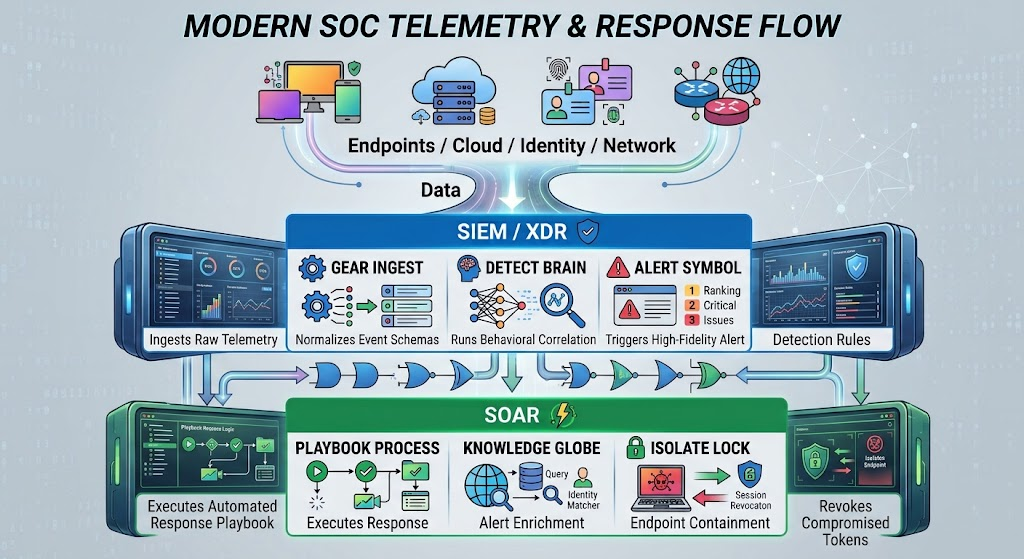
In a modern SOC workflow, these systems operate together: an XDR sensor flags malicious memory injection on an endpoint; the SIEM correlates that event with an unusual VPN login logged from another region; and the SOAR engine automatically revokes the user’s active session while isolating the infected host.
How to Choose a SIEM Tool for Your Security Operations Team
Selecting the right SIEM platform requires balancing technical capabilities against your organization’s operational reality.
Key factors to evaluate during the procurement process include:
- Existing Ecosystem Alignment: Choose a tool that natively supports your core infrastructure. Organizations running predominantly on Microsoft Azure benefit naturally from Microsoft Sentinel, while Palo Alto or CrowdStrike shops gain rapid value from Cortex XSIAM or Falcon Next-Gen SIEM.
- Daily Ingestion & Data Retention Costs: Analyze pricing models carefully. Volume-based ingestion pricing (per-GB/day) can become unpredictable as network log volumes grow. Evaluate options with flat-rate, workload-based, or multi-tier storage models to avoid unexpected budget overruns.
- Detection Engineering Capabilities: Determine whether your team has the resources to write and maintain custom detection queries (using KQL, SPL, or YARA-L) or if you require a platform with pre-packaged, vendor-managed detection rules.
- SOC Staffing & Technical Maturity: Highly customizable platforms like Splunk or self-managed Elastic require dedicated platform engineers to maintain performance. Lean teams should prioritize cloud-native solutions like Rapid7 InsightIDR that reduce administrative drag.
- Compliance & Auditing Standards: Ensure the platform provides built-in compliance frameworks and long-term cold storage options matching your regulatory obligations (such as PCI DSS, HIPAA, or SOC 2).
- Total Cost of Ownership (TCO): Factor in indirect costs beyond the software license, including implementation services, storage infrastructure, API connector fees, and specialized engineering salaries.
Frequently Asked Questions
What is the most effective SIEM tool for security operations?
There is no single best tool for every SOC. Microsoft Sentinel and Google Security Operations excel in cloud-native enterprise environments, Splunk Enterprise Security leads in granular customization and complex analytics, while Rapid7 InsightIDR suits leaner teams seeking turnkey detection out of the box.
Which SIEM tools are best for enterprise security operations?
Large enterprise environments typically evaluate Splunk Enterprise Security, Microsoft Sentinel, Google Security Operations, IBM QRadar, or Palo Alto Networks Cortex XSIAM due to their petabyte-scale processing and deep ecosystem integrations.
Is Microsoft Sentinel better than Splunk Enterprise Security?
Microsoft Sentinel offers easier setup, cloud-native scalability, and seamless integration for Azure-centric organizations. Splunk ES provides superior query flexibility via SPL, multi-cloud neutrality, and advanced Risk-Based Alerting for complex, multi-vendor environments.
What is the difference between a SIEM and a SOC?
A SIEM is a software platform used to collect, correlate, and analyze security log data. A SOC (Security Operations Center) is the team of security professionals, processes, and technologies responsible for monitoring, investigating, and responding to security threats across an organization.
Can SIEM tools detect ransomware attacks?
Yes. SIEM tools detect ransomware by correlating early indicators across multiple log sources, such as unusual administrative commands, mass file modifications, shadow copy deletion events, and command-and-control network connections.
Are open-source SIEM tools effective for enterprise security?
Open-source tools like Wazuh and Elastic Security are highly effective, provided the organization has experienced security engineers to configure parsing rules, optimize database performance, and maintain infrastructure.
How much does SIEM software cost?
SIEM pricing varies widely based on licensing models, including volume-based ingestion ($/GB per day), user/node counts, endpoint counts, or cloud compute units. Small deployments may cost $10,000 to $30,000 annually, while large enterprise deployments routinely exceed $100,000 to $500,000+ per year.
Do small businesses need a SIEM solution?
Small businesses with limited IT staff often find managing a traditional SIEM overwhelming. They typically benefit more from deploying a Managed Detection and Response (MDR) service or an approachable, low-maintenance SIEM like Rapid7 InsightIDR.