
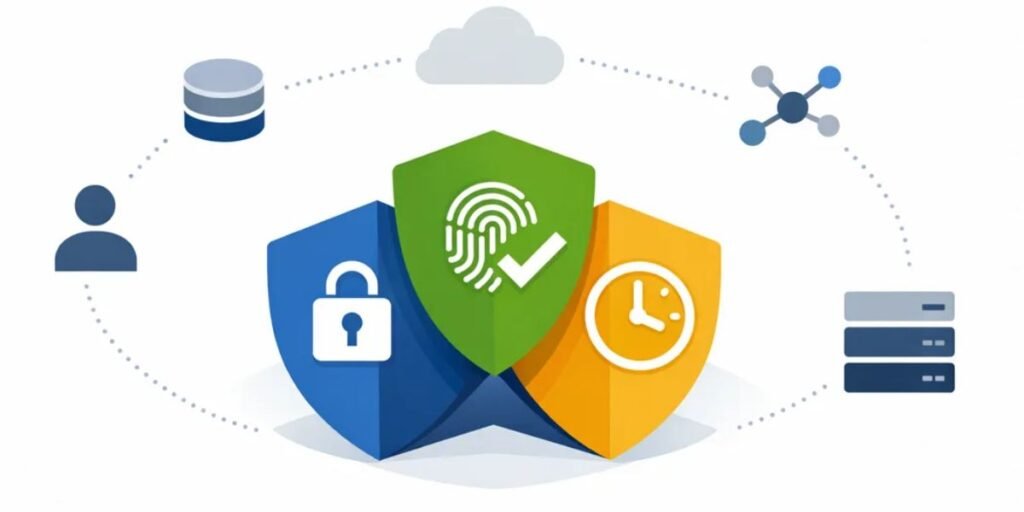
Information security examinations and professional training modules regularly test your ability to differentiate between the core pillars of the CIA triad: confidentiality, integrity, and availability. While these concepts sound straightforward in isolation, test questions often use practical scenarios that overlap, causing test-takers to choose the wrong security objective.
The core distinctions rest on three specific outcomes:
- Confidentiality governs who can view or access data, ensuring sensitive information stays hidden from unauthorized entities.
- Integrity guarantees that data remains accurate, complete, and uncorrupted by unauthorized modifications or destruction.
- Availability ensures that authorized users have reliable, timely access to systems and data whenever business operations require it.
Understanding how standards organizations like the National Institute of Standards and Technology (NIST) define these principles is essential for matching each component to its correct description accurately.
The Correct Matches for the Information Security Components
The table below provides the direct matching answers based on NIST SP 800-12 and NIST SP 800-33 terminology.
| Information Security Component | Correct Description | Key Phrase to Recognize |
| Confidentiality | Protects information against unauthorized access or disclosure. | Authorized access |
| Integrity | Protects information against unauthorized modification or destruction and supports its accuracy and completeness. | Accuracy and changes |
| Availability | Ensures authorized users can access and use information when required. | Timely access |
How to Recognize Each Information Security Component
Recognizing these components on a test requires looking past technical tools and identifying the fundamental business risk being addressed.
Confidentiality: Protecting Information From Unauthorized Access
Confidentiality focuses exclusively on privacy, access restrictions, and preventing data leakage to unauthorized individuals, processes, or devices. When data is kept confidential, unauthorized parties cannot read or extract its contents even if they physically intercept the storage media or transmission stream.
Consider an enterprise human resources database containing employee compensation records, social security numbers, and home addresses. Role-Based Access Control (RBAC) limits visibility so payroll specialists can process salary data while standard staff members cannot view their colleagues’ financial records. If a junior employee bypasses folder permissions to read an executive’s salary history without altering it, confidentiality is the sole security pillar compromised.
Organizations rely on several technical controls to enforce confidentiality:
- Encryption protocols such as AES-256 for data at rest and TLS 1.3 for data in transit
- Access Control Lists (ACLs) and strict Least Privilege policies
- Multi-Factor Authentication (MFA) to verify user identity before granting viewing rights
- Data Loss Prevention (DLP) systems that inspect outbound network traffic for unencrypted sensitive files
It is vital to distinguish authentication from authorization. Authentication verifies who you are, whereas authorization determines what records you have permission to view. Both mechanisms support confidentiality, but neither is identical to it.
When analyzing matching items, look for verbs such as viewing, disclosing, intercepting, reading, or exposing. Any description centered on keeping secrets or limiting visibility maps directly to confidentiality.
Confidentiality does not require keeping data hidden from everyone. It requires enforcing access boundary rules so that only verified, authorized entities possess viewing privileges while everyone else is excluded.
Integrity: Keeping Information Accurate and Protected From Improper Changes
Integrity centers on trustworthiness, accuracy, and operational completeness. This component ensures that data remains in its original, intended state from creation through storage, processing, and transmission, remaining uncorrupted by malicious tampering or system error.
In financial infrastructure, imagine a core banking platform processing an electronic funds transfer of $1,000. If an attacker performs a Man-in-the-Middle (MitM) injection that alters the recipient account number or inflates the transaction value to $100,000 during transit, the bank faces an integrity breach. The privacy of the account holder may remain intact, but the data itself is no longer accurate or trustworthy.
Technical mechanisms designed to protect integrity include:
- Cryptographic hash functions such as SHA-256 to generate unique file digest baselines
- Digital signatures that combine hashing with asymmetric encryption to provide non-repudiation
- File Integrity Monitoring (FIM) agents that log unauthorized registry or system file changes
- Version control systems, database transaction logs, and immutable audit trails
A cryptographic hash reveals whether a file was modified by comparing its calculated checksum to a known baseline value. However, a hash algorithm alone does not stop a file from being edited; it simply detects tampering after the event occurs.
Distinguish unauthorized alterations from legitimate database updates. System records change constantly during standard operations. Integrity is violated only when changes occur without authorization, through system failure, or via improper processing.
When matching descriptions on an exam, highlight keywords like tampering, modifying, checksum, accuracy, deleting, corrupting, or validating. If the question describes unauthorized edits or altered records, integrity is your target match.
Availability: Ensuring Authorized Users Can Access Information When Needed
Availability addresses operational continuity and user access. A secure system must remain functional and accessible to authorized personnel whenever business needs require its services.
Consider a regional hospital system during a mass casualty event. The emergency department’s Electronic Health Record (EHR) database contains fully encrypted, perfectly accurate patient files. However, if a Distributed Denial of Service (DDoS) attack overloads the hospital’s internal network switches, doctors cannot pull up life-saving allergy histories or blood types. Despite strong confidentiality and integrity, the security architecture fails because availability was destroyed.
Engineers maintain high availability through robust infrastructure planning:
- Redundant hardware configurations, such as dual power supplies and RAID 10 disk arrays
- Load balancers that distribute incoming web traffic across redundant server clusters
- Automated failover systems and secondary hot sites located in different power grids
- Data backups backed by regularly tested Recovery Time Objectives (RTO) and Recovery Point Objectives (RPO)
- DDoS mitigation services that scrub malicious traffic surges before they reach core routers
High availability does not mean a server must maintain 100% uptime indefinitely without maintenance. Rather, system accessibility must meet established Service Level Agreements (SLAs) negotiated by the organization.
Test questions focused on availability emphasize operational readiness. Key phrases include uptime, business continuity, disaster recovery, system outage, redundancy, denial of service, and timely access.
How to Tell Confidentiality, Integrity, and Availability Apart
When questions present complex real-world scenarios, identifying the primary compromised component requires looking at the direct consequence of the incident.
Consider how three distinct incidents affect an enterprise customer database:
| Incident Scenario | Primary Component Affected | Underlying Technical Reason |
| An attacker steals unencrypted customer credit card numbers from a cloud bucket. | Confidentiality | Sensitive records were exposed to an unauthorized third party. |
| A database bug overwrites existing customer account balances with null values. | Integrity | Data accuracy was destroyed through improper data corruption. |
| A power grid failure takes down the primary data center, rendering the customer portal offline. | Availability | Authorized users cannot connect to necessary services or files. |
Security incidents rarely stay confined to a single pillar. A modern ransomware infection provides a clear example of multi-component overlap.
When ransomware infiltrates an enterprise endpoint, it executes asymmetric encryption across local hard drives. This action destroys availability because legitimate users cannot open their operational files.
Simultaneously, the unauthorized modification of file headers damages data integrity. If the ransomware operators also exfiltrate corporate files to an external command-and-control server before encrypting them, a severe confidentiality breach occurs as well.
Evaluating exam questions requires isolating the specific goal highlighted in the prompt rather than overthinking secondary impacts.
A Simple Method for Matching Descriptions in an Exam
When faced with ambiguous scenarios on certification exams like CompTIA Security+, CISSP, or GIAC GISP, apply this decision framework to find the correct answer:
- Isolate the Core Action: Determine the primary problem described in the question prompt. Strip away technical jargon to identify if the event involves viewing data, changing data, or reaching a system.
- Locate the Trigger Clue: Match the core action to its core security objective:
- Seeing, copying, or leaking data →\rightarrow→ Confidentiality
- Editing, deleting, corrupting, or falsifying data →\rightarrow→ Integrity
- Crashing, blocking, locking, or slowing access →\rightarrow→ Availability
- Separate Safeguards From Objectives: Do not confuse the tool with the goal. Encryption is a safeguard; confidentiality is the objective. Data backups are a safeguard; availability is the objective. Focus on what the business is trying to achieve.
- Evaluate the Complete Prompt: Read every word in the description carefully before selecting an option. Distinguish between questions asking for the compromised state versus the intended defensive control.
- Verify Against the Core Pillars: Confirm your selection by asking three direct baseline questions:
- Was information disclosed improperly? (Confidentiality)
- Was information modified improperly? (Integrity)
- Was service access denied improperly? (Availability)
Security Terms That Are Easy to Confuse With the CIA Triad
Security standards incorporate several supporting concepts alongside the core triad. Conflating these terms with confidentiality, integrity, or availability is a common source of test errors.
Authentication and Authorization
Authentication validates claimed identity using credentials like passwords, hardware tokens, or biometric scans. Authorization checks permission matrices to grant or deny access to specific resources. Both support confidentiality and integrity, but they represent functional access control steps rather than independent CIA pillars.
Accountability and Non-Repudiation
Accountability ensures that system actions can be traced directly to a specific user or process through system logs. Non-repudiation uses digital signatures and public key infrastructure (PKI) to provide proof of origin, preventing an individual from denying their involvement in a transaction. While critical to auditability, these are supporting operational principles.
Encryption and Backups
Encryption converts plaintext into ciphertext using cryptographic keys. It serves as a defensive mechanism to enforce confidentiality and, when combined with message authentication codes (MACs), support integrity. Backups are operational copies of data created to restore systems following data loss, directly supporting availability and disaster recovery.
Practice Questions: Match Each Scenario to the Correct Component
Test your understanding with these practice questions.
Question 1
A financial firm implements strict file permissions and Multi-Factor Authentication to prevent unauthorized employees from opening merger and acquisition files. Which security component is being protected?
- Answer: Confidentiality
- Explanation: Restricting file access so only authorized personnel can view sensitive documents directly protects information against unauthorized disclosure.
Question 2
An attacker intercepts an unencrypted administrative command sent to a network switch and alters the destination IP address of the routing table. Which component is directly breached?
- Answer: Integrity
- Explanation: Unauthorized modification of network configuration data in transit damages the accuracy and reliability of system information.
Question 3
A web server experiences a hardware controller failure, causing the primary ecommerce portal to go offline for four hours during peak business times. Which component is affected?
- Answer: Availability
- Explanation: The hardware failure prevents authorized customers from accessing the web application and completing transactions.
Question 4
A system administrator configures a secondary server array that automatically synchronizes database writes and takes over traffic if the primary server fails. Which component does this measure support?
- Answer: Availability
- Explanation: Redundant hardware arrays and automated failover mechanics ensure continuous, timely access to corporate systems.
Question 5
A company discovers that a former employee used valid credentials to log into a network folder and corrupt historical accounting spreadsheets by inserting random numerical values. Which component was violated by the data corruption, and did another component fail during the login?
- Answer: Primary violation: Integrity; Secondary failure: Confidentiality
- Explanation: Inserting false values corrupts the accuracy and trustworthiness of accounting records (integrity). Accessing private corporate files without ongoing employment authorization also represents an unauthorized access event (confidentiality).
Quick Review: The Three Components at a Glance
| If the description emphasizes… | Match it with… |
| Preventing unauthorized viewing, exposure, or data leaks | Confidentiality |
| Restricting who can open or read sensitive files | Confidentiality |
| Maintaining accuracy, correctness, and completeness | Integrity |
| Preventing unauthorized edits, tampering, or deletion | Integrity |
| Ensuring reliable, timely access to services and systems | Availability |
| Deploying redundant hardware and tested recovery backups | Availability |
References
National Institute of Standards and Technology. (2017). An Introduction to Information Security (NIST Special Publication 800-12, Revision 1). U.S. Department of Commerce.
National Institute of Standards and Technology. (2001). Underlying Technical Models for Information Technology Security (NIST Special Publication 800-33). U.S. Department of Commerce.
International Organization for Standardization. (2022). Information security, cybersecurity and privacy protection — Information security management systems — Requirements (ISO/IEC Standard No. 27001:2022). ISO/IEC.