

Federal agencies produce and process vast volumes of sensitive data every day, ranging from internal personnel memos to operational military strategies. However, simply being sensitive, proprietary, or confidential does not automatically authorize information to be marked as classified. The federal government maintains strict legal standards to prevent over-classification and to ensure that secrecy is applied solely to safeguard vital state interests.
The framework governing national security classification rests primarily on Executive Order 13526, signed by President Barack Obama in December 2009. This executive order establishes the precise criteria, procedures, and statutory categories required to designate information as classified. To qualify, data must fit into specific designated categories and pass a rigorous harm threshold regarding potential damage to the nation.
Understanding the legal mechanism behind classification requires examining both the authorized categories defined by federal law and the mandatory conditions that an Original Classification Authority (OCA) must fulfill before applying a classification mark to any government document.
When Can Information Be Classified Under Executive Order 13526?
Under Section 1.1 of Executive Order 13526, information cannot be classified arbitrarily. A document, system, or record is eligible for classification only when four specific conditions are met simultaneously during the original classification process.
First, the classification decision must be made by an authorized Original Classification Authority (OCA). This is an official who has been granted explicit statutory authority by the President or designated in writing by agency heads such as the Secretary of Defense or the Director of National Intelligence.
Second, the information must be owned by, produced by or for, or controlled by the United States Government. Private sector information created independently without federal funding, contracts, or government oversight cannot be classified under this executive order unless it falls under specific statutory secrecy laws like the Atomic Energy Act of 1954.
Third, the subject matter must fall within at least one of the specific authorized categories defined in Section 1.4 of Executive Order 13526. If a piece of information does not fit any of these explicit statutory categories, it cannot be classified, regardless of how sensitive or confidential agency officials consider it to be.
Fourth, the original classification authority must determine that the unauthorized disclosure of the information reasonably could be expected to result in identifiable damage to national security. The authority must be able to identify or describe the specific damage that disclosure would cause to the defense, foreign relations, or operational capabilities of the United States.
This legal framework specifically outlines that besides protecting national security information may be classified if it falls directly within one of the designated categories listed in Section 1.4 and meets the mandatory harm threshold evaluated by an authorized official.
Seven Categories of Information Commonly Associated With National Security Classification
While Executive Order 13526 enumerates eight distinct statutory categories under Section 1.4, these categories are frequently grouped into core functional areas for operational and administrative guidance across executive branch agencies.
Every classified document in the federal government must explicitly cite at least one of these statutory categories in its classification header or administrative marking block.
Military Plans, Weapons Systems, and Operations
Section 1.4(a) authorizes the classification of information concerning military plans, weapons systems, or operations. This covers tactical deployment schedules, force posture logistics, strategic targeting priorities, and operational orders.
It also protects technical specifications and performance limitations for advanced military hardware, such as radar cross-section data for stealth aircraft, submarine acoustic signatures, and electronic warfare countermeasures. Disclosing these details gives potential adversaries direct insights into tactical vulnerabilities and combat capabilities.
Intelligence Activities, Sources, Methods, and Cryptology
Section 1.4(c) protects intelligence activities, intelligence sources or methods, and cryptology. This is one of the most heavily guarded categories across the United States Intelligence Community (IC).
An intelligence source refers to a human asset or technical collection platform providing vital information. Intelligence methods involve the operational techniques, satellite collection orbits, and signals intercept capabilities used to gather data. Cryptology encompasses the mathematical encryption algorithms, key management systems, and codebreaking techniques managed by agencies such as the National Security Agency (NSA). Disclosing sources or methods can result in the immediate compromise of technical collection systems or the physical loss of human assets operating abroad.
Foreign Government Information and U.S. Foreign Relations
Information concerning foreign relations or foreign activities of the United States, including confidential sources, is protected under Section 1.4(b). Section 1.4(e) separately protects Foreign Government Information (FGI) provided to the United States under expectations of confidentiality.
Diplomatic communications, treaty negotiations, confidential bilateral agreements, and backchannel communications between heads of state require strict protection. Revealing confidential foreign relations data can damage diplomatic trust, disrupt international coalitions, and lead to immediate retaliatory actions against American diplomatic and commercial interests overseas.
Scientific, Technological, and Economic Information Related to National Security
Under Section 1.4(f), scientific, technological, or economic matters related to national security may be classified. This category does not cover general academic research or routine economic reports issued by federal statistics bureaus.
To qualify, the scientific or technological research must have a direct defense application, such as hypersonic propulsion dynamics, directed energy technology, or advanced quantum encryption frameworks. Similarly, economic information qualifies only when disclosure would disrupt critical national supply chains, reveal strategic economic warfare countermeasures, or expose national defense stockpiles.
U.S. Government Nuclear Materials and Facilities
Section 1.4(g) authorizes the classification of information regarding United States Government programs for safeguarding nuclear materials or facilities.
This category covers physical security plans for nuclear weapons storage sites, transportation routes for weapons-grade fissile material, anti-sabotage protocols for nuclear reactors, and emergency response procedures for radiological incidents. Protecting this information prevents non-state actors or hostile nations from identifying structural vulnerabilities in nuclear infrastructure.
National Security Systems, Infrastructure, and Vulnerabilities
Under Section 1.4(h), agencies can classify information relating to vulnerabilities or capabilities of systems, installations, infrastructures, projects, plans, or protection services relating to national security.
This includes architectural blueprints for critical command facilities, cybersecurity defense postures for federal networks, continuity of government plans, and physical protection details for senior government officials. Exposing these system vulnerabilities allows hostile actors to plan effective cyberattacks, physical intrusions, or targeted disruptions against vital government infrastructure.
Weapons of Mass Destruction
Section 1.4(d) establishes a dedicated category for information concerning weapons of mass destruction.
This encompasses the chemical synthesis steps, biological agent weaponization protocols, radiological dispersion device mechanics, and nuclear weapon design parameters. Given the catastrophic risks associated with non-proliferation, technical details that lower the barrier for developing or weaponizing chemical, biological, radiological, or nuclear weapons are maintained under tight classification boundaries.
What Does Not Qualify as a Valid Reason for Classification?
While Executive Order 13526 establishes broad categories for protecting national security information, it imposes strict statutory prohibitions to prevent secrecy from being misused. Section 1.7 of Executive Order 13526 explicitly outlines conditions under which classification is illegal.
Federal agencies and classification authorities are strictly prohibited from classifying information to:
- Conceal violations of law, inefficiency, or administrative error
- Prevent embarrassment to a person, organization, or agency
- Restrain competition in commercial markets
- Prevent or delay the release of information that does not require protection in the interest of national security
Classification cannot be used as an administrative shield to avoid public accountability or legal scrutiny. If a document reveals waste, fraud, abuse, or illegal surveillance activities, classifying it solely to hide those facts violates federal regulations.
Furthermore, basic scientific research data that is not clearly linked to national security cannot be classified. Restricting open academic or scientific inquiry without a direct, identifiable defense justification undermines broader technological innovation and violates government transparency standards.
How Confidential, Secret, and Top Secret Classification Differ
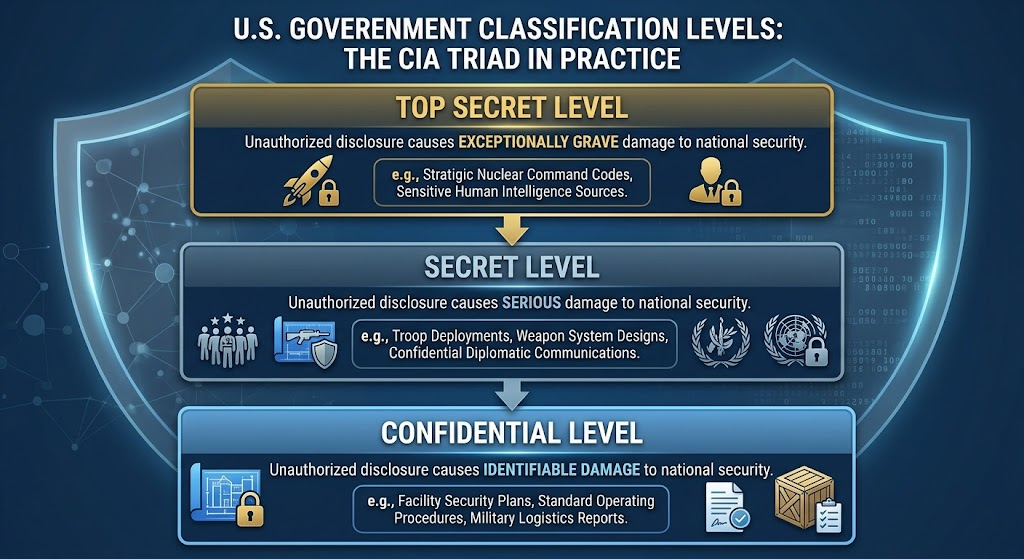
Classification levels reflect the degree of potential harm that unauthorized disclosure would cause to national security, rather than serving as separate categories of information. Section 1.2 of Executive Order 13526 defines three official classification tiers:
- Top Secret: Applied to information where unauthorized disclosure reasonably could be expected to cause exceptionally grave damage to national security. Examples include operational plans for ongoing armed conflicts, strategic nuclear command codes, and sensitive human intelligence sources operating in hostile nations.
- Secret: Applied to information where unauthorized disclosure reasonably could be expected to cause serious damage to national security. This includes advanced weapon system designs, tactical troop movements, and confidential diplomatic communications regarding international crisis negotiations.
- Confidential: Applied to information where unauthorized disclosure reasonably could be expected to cause damage to national security. Examples include routine military logistics reports, technical manuals for non-critical hardware, and operational security guidelines for government facilities.
No other classification markings, such as “Official Use Only” or “Controlled Unclassified Information” (CUI), indicate classified status. Those markings apply to unclassified information that requires handling restrictions under other legal authorities.
Original Classification vs. Derivative Classification
The process of classifying government records falls into two distinct operational categories: original classification and derivative classification.
Original classification is the initial determination that a specific piece of information requires protection against unauthorized disclosure in the interest of national security. This process requires evaluating the subject matter against Section 1.4 categories, determining the potential damage level, setting declassification instructions, and marking the document officially.
Derivative classification involves incorporating, paraphrasing, restating, or generating in a new form information that is already classified. Most government employees and defense contractors who handle classified documents perform derivative classification.
When a contractor writes a technical summary using data from an existing classified source document or a Security Classification Guide (SCG), they apply derivative classification markings based on the authority established by the original classification decision.
Who Has the Authority to Classify Information?
Original classification authority is granted sparingly across the federal government to maintain accountability and prevent rampant over-classification.
Authority flows from the President under executive privilege and statutory designation:
- Top Secret OCA: Granted to the President, Vice President, cabinet secretaries, heads of major intelligence agencies, and military department secretaries.
- Secret and Confidential OCA: Delegated in writing by agency heads who possess Top Secret authority to specific senior officials with a demonstrated operational need.
An individual employee’s personal belief or judgment that a document is sensitive does not make it classified. Unless an official holds explicit, written OCA delegation for that specific domain, they cannot make an original classification determination.
Conclusion
Determining whether information can be classified depends on a strict statutory standard established by Executive Order 13526. Information is not classified based on sensitivity, commercial value, or potential political embarrassment.
To be legally classified, data must be owned or controlled by the U.S. government, fall directly within one of the authorized categories under Section 1.4, and carry an identifiable risk of damage to national security as determined by a certified Original Classification Authority. Understanding these boundaries ensures that national security assets remain protected while upholding government transparency and legal accountability.