
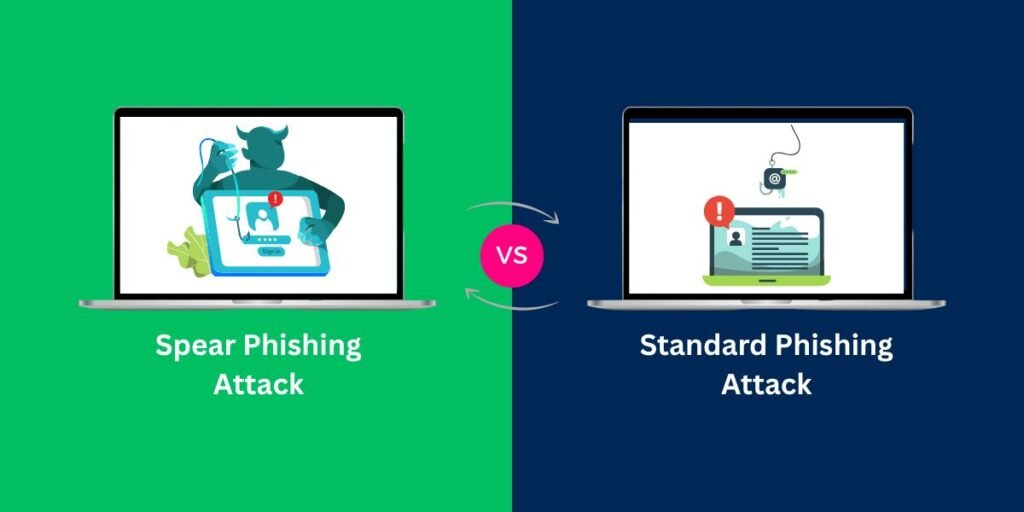
Most security teams use the two terms as if they meant the same thing. They do not behave the same way once an attacker decides who to go after. Standard phishing targets large audiences with generic, automated messages. Spear phishing targets selected individuals or organizations using personalized context.
Spear phishing is not a separate class of cybercrime. It is a targeted subset of phishing that relies on customized research instead of mass volume. Both methods aim to breach digital perimeters, steal credentials, or trigger fraudulent financial transactions.
The scale of the problem is documented. The FBI’s Internet Crime Complaint Center (IC3) published its 2025 report in April 2026 and recorded 1,008,597 complaints and $20.877 billion in reported losses, a 26% jump from the year before. Phishing and spoofing produced the most complaints, while the costliest schemes were the targeted, relationship-based ones. Understanding how targeting, message preparation, risk, and prevention differ gives organizations a realistic basis for building defenses.
What Is Standard Phishing?
Standard phishing is a volume-driven attack in which threat actors send fraudulent messages to thousands or millions of potential victims at once. Attackers treat it as a numbers game. Even a tiny response rate pays off when the message costs almost nothing to send.
Mass campaigns usually impersonate organizations that command automatic trust or urgency. The usual choices are major retail banks, parcel delivery services, cloud storage platforms, popular email providers, and municipal utilities. Recipients already have a relationship with at least one of these brands, which is exactly why the lure works on a small slice of any large list.
The goal is collecting sensitive data at scale. Attackers go after login credentials, credit card details, and personally identifiable information. Some campaigns push malware through malicious links and attachments instead. The FBI logged 191,561 phishing and spoofing complaints in 2025 and reported that losses tied to them rose from $70 million to $215.8 million. Complaint volume stayed roughly flat, so the jump came from higher losses per incident and not from more victims reporting.
Verizon’s 2026 Data Breach Investigations Report (DBIR) puts the technique in perspective. Phishing was the initial access vector in 16% of breaches in the report window running from November 2024 to October 2025. That makes it a leading entry point even in a year when vulnerability exploitation took the top spot overall.
Here is what a typical mass phishing message looks like:
Subject: Urgent: Your Account Has Been Temporarily Suspended
From: Security Support no-reply@service-update-portal-check.com
Dear Customer,
We detected unauthorized login attempts on your account. Your access has been restricted.
Please click the link below to verify your identity within 24 hours to prevent permanent account closure.
[Verify Account Credentials Now]
The template has no personal name, no account number, and no contextual detail. Millions of people can receive this exact text. It depends entirely on recipient anxiety to force a fast, unthinking click. The tells are easy to spot once you slow down. The greeting is generic, the sender domain has nothing to do with a real company, and the deadline exists only to rush you.
What Is Spear Phishing?
Spear phishing starts with a decision about who to attack. Attackers pick specific individuals, operating teams, or organizations before they write a single word. Instead of casting a wide net, they spend effort on named targets whose access, authority, or data makes them valuable.
Preparation is systematic and relies on publicly available sources. Attackers harvest details from corporate websites, professional network profiles, personal social media accounts, vendor press releases, and credentials leaked in earlier third-party breaches. A job title on a networking site, a press release about a new vendor, and a conference photo can be enough to build a convincing story.
Impersonation usually involves someone close to the target. The sender may pose as a company executive, a direct manager, an internal IT technician, a supply chain partner, legal counsel, or an active vendor.
The financial stakes explain why this style of attack gets so much attention. The FBI recorded 24,768 business email compromise (BEC) complaints in 2025 with reported losses of $3,046,598,558, which made BEC the second costliest crime type behind investment fraud. BEC is not identical to spear phishing, but the two overlap heavily. Industry summaries of the report describe BEC as a socially engineered, spear-phishing-style scheme that often needs no malicious link or malware at all.
The per-complaint math shows the gap clearly. Dividing BEC losses by BEC complaints gives roughly $123,000 per complaint. Dividing phishing and spoofing losses by their complaints gives roughly $1,100. That is a difference of more than one hundred times, and it comes from targeting and context.
Here is a spear phishing message built around a real business relationship:
Subject: Updated Settlement Wiring Instructions – Project Apex
From: Mark Davis m.davis@consulting-partners-group.net
Hi Sarah,
Following up on our call yesterday regarding the final closing documents for Project Apex.
Our finance department updated our escrow routing details for the remaining Q3 invoice.
Attached is the revised payment schedule on our firm letterhead. Please process the wire transfer of $142,500 before 3:00 PM EST today so we stay on schedule for Monday.
Best,
Mark
The attack works because it references a real project name, an accurate closing timeline, and a legitimate business relationship. Every detail matches the target’s daily workflow. The only real warning signs are the changed banking details, the same-day deadline, and a sender domain that sits close to the genuine firm’s name.
Personalization makes a fraudulent message far more persuasive, but it does not guarantee success. Organizations that enforce strong multi-factor authentication, out-of-band verification, and layered security controls can stop even highly tailored attempts. A convincing email still has to survive the payment process behind it.
Spear Phishing vs. Standard Phishing: The Main Differences
The core difference is the degree of preparation, selection, and customization before the message goes out. Seven factors separate the two approaches in practice.
- Target Audience: Standard phishing reaches the mass public through broad email lists and random phone numbers. Spear phishing aims at named individuals, specific corporate roles, or chosen organizations.
- Message Personalization: Mass campaigns lean on generic greetings and template language. Spear phishing uses real names, project details, and the terminology a company actually uses internally.
- Information Gathering: Standard campaigns need little or none, since automated scraping supplies the address lists. Spear phishing involves extensive research across social media, corporate registries, and breach data.
- Impersonation Methods: Mass campaigns copy major consumer brands, banks, tech providers, and utilities. Targeted attacks copy executives, managers, direct colleagues, and specific legal or vendor partners.
- Delivery Patterns: Standard phishing goes out as bulk distribution and automated email blasts. Spear phishing arrives as a small number of carefully timed messages sent to specific people.
- Potential Objectives: Mass campaigns pursue credential harvesting, general identity theft, and malware drops. Targeted campaigns pursue high-value wire transfers, proprietary intellectual property, and network access.
- Primary Warning Signs: For standard phishing, the signals are generic salutations, mismatched domain names, and broad urgency. For spear phishing, the signals are out-of-band payment changes, unusual urgency from known contacts, and subtle domain spoofs.
The distinction comes down to depth of target selection and context. It does not come from the objective or the delivery mechanism. Both methods routinely use deceptive links, fake login portals, malicious attachments, and credential-harvesting scripts. A practical way to think about it is that standard phishing exploits a brand relationship, while spear phishing exploits a personal or professional one.
Examples of Standard Phishing and Spear Phishing
Real-world scenarios show how the two approaches play out. The mechanics are similar, but the economics and the victim experience are very different.
A Generic Email Designed to Reach Thousands of People
An attacker builds a fake login page that mirrors a popular cloud document sharing service. Using automated tools, the attacker sends a generic notification to half a million scraped business email addresses.
The email claims that a document titled Invoice_Details.pdf is waiting for review and requires an immediate login. Thousands of recipients use that cloud service every day, so a percentage will click without checking the sender address. The campaign depends on probability and message volume to collect credentials.
Most recipients ignore it, and mail filters catch a share of it. The attacker only needs a handful of employees to type their passwords into the fake page. Those stolen credentials can later be sold or used to launch a more targeted attack against the same company.
A Targeted Message Aimed at One Employee
An attacker researches a middle-market manufacturing company and identifies a senior payroll specialist on a professional network. Through public news releases, the attacker learns that the company recently selected a new health insurance provider.
The attacker registers a domain that differs by a single letter from the real provider’s domain. They send a direct email to the payroll specialist, addressing the person by name, referencing the new insurance rollout, and requesting updated employee direct deposit schedules.
The contextual details make the request feel routine, so the employee is far more likely to respond without questioning the sender’s identity. This pattern shows up often in payroll diversion fraud. The request looks like normal administrative work, and the damage appears only when employees notice missing paychecks.
Why Spear Phishing Can Be Harder to Detect
Spear phishing slips past routine mental filters because the message fits the victim’s daily work. When an email contains correct internal jargon, legitimate project titles, and real business partner names, people read the context as proof of authenticity. Their guard drops before they have examined a single technical detail.
Attackers choose their moment deliberately. They tend to time messages around busy operational windows such as end-of-month financial reconciliations, audits, or corporate restructurings. Employees working under tight deadlines are less likely to stop and verify a request that looks routine.
Relying on poor spelling and broken grammar as a defense no longer works. Verizon’s 2026 DBIR found that among initial access methods assisted by large language models, phishing was the most common at 44%, followed by vulnerability exploitation at 32% and credential abuse at 21%. The same report draws on more than 31,000 incidents and 22,000 confirmed breaches across 145 countries and highlights a growing use of voice and other mobile-centric social engineering aimed at people in the middle of the workday.
The FBI is now tracking AI directly. In 2025, the IC3 recorded 22,364 complaints that mentioned AI, with $893,346,472 in reported losses. Within BEC specifically, it counted 135 complaints mentioning AI and about $30.3 million in losses. Those figures include only victims who knew or suspected AI was involved, so they almost certainly understate real activity.
Standard phishing can also look polished, with convincing branding and clean formatting. What spear phishing adds is targeted context that is difficult to verify at a glance. Its success still depends on the target’s internal controls and verification habits. A flawless email asking for a wire transfer fails when the payment process requires a call to a known number.
How to Protect Against Both Types of Phishing
Protecting an organization takes technical email controls combined with clear operating policies. No single layer is enough, because each attack type defeats a different layer.
- Verify payment and data requests out of band: Any request involving bank routing changes, wire transfers, or sensitive data sharing should be confirmed through a separate channel. Call a phone number already on file, not one printed in the email. Finance teams that follow this rule consistently stop most payment fraud before money leaves the account.
- Inspect the sender, not just the display name: Look closely at sender domains, email headers, and embedded links. A display name can say anything, and one swapped letter in a domain is easy to miss on a phone screen.
- Move to phishing-resistant authentication: The Cybersecurity and Infrastructure Security Agency (CISA) states that FIDO/WebAuthn is the only widely available phishing-resistant authentication and urges all organizations to adopt it. Where that is not yet possible, CISA recommends number matching for push-based MFA to reduce the risk of approval fatigue. Hardware-backed passkeys also blunt credential reuse, since a stolen password alone no longer opens the door.
- Authenticate your own domain and filter inbound mail: Maintain DMARC, DKIM, and SPF records along with advanced email security filtering and endpoint protection. These controls help block direct spoofing of your own domain. They do not stop a lookalike domain that an attacker registers separately, which is why they work best alongside verification procedures.
- Train on realistic scenarios: Scenario-based awareness training should reflect real executive and vendor impersonation, including voice and text message variants. Generic training that focuses on typos misses how modern campaigns actually look.
- Require dual authorization for payments: Outgoing payments and banking detail changes above a set threshold should need two approvals from two different people. This one control breaks the BEC model, since an attacker would have to deceive two employees at once.
- Report and act quickly after a mistake: If money has moved, notify the financial institutions involved immediately and file a complaint at the FBI’s IC3 portal. The FBI credits a recovery effort for reducing potential losses by more than $500 million since 2024. Speed is the most important variable once a fraudulent transfer has been sent.
Individual vigilance has to be backed by automated organizational controls. When technical guardrails are configured properly, a compromised credential or an accidental click does not automatically become a full system breach.
Is Spear Phishing the Same as Whaling?
Whaling is a specific subset of spear phishing that targets high-profile individuals. These include chief executive officers, chief financial officers, board members, and senior government officials.
Spear phishing can reach staff at any level of an organization. Whaling focuses on executives because they hold elevated system access or direct authority over financial transactions. A successful whaling attack can unlock large wire transfers, confidential strategy documents, or privileged accounts in a single step.
Executives are also targets because their information is easy to find. Speaking engagements, press coverage, and regulatory filings give attackers material for believable messages. Organizations should extend the same verification rules to executives and their assistants, since assistants often handle the exact requests attackers want to imitate.
Frequently Asked Questions
Is spear phishing a type of phishing?
Yes. Spear phishing is a targeted variant of phishing. It uses the same fundamental techniques, including deceptive messaging, impersonation, and fraudulent links or attachments. The difference is that it applies them to specific, researched targets instead of broad audiences.
Is spear phishing more dangerous than standard phishing?
Spear phishing often carries a higher risk for organizations because personalized messaging achieves better success rates and aims at high-value assets. The FBI’s 2025 data supports this. BEC produced roughly $123,000 in losses per complaint, compared with roughly $1,100 for phishing and spoofing complaints. The real level of danger still depends on the target’s access, existing technical controls, and how fast the organization responds to an incident.
Can spear phishing happen through text messages?
Yes. Targeted phishing can arrive by text message (smishing), phone call (vishing), messaging apps, and social media platforms. Attackers switch channels when the target is easier to reach on a phone. Verizon’s 2026 DBIR notes the growing role of voice and mobile-centric tactics, which means verification rules need to cover calls and texts and not only email.
What is the easiest way to distinguish spear phishing from standard phishing?
Look at target selection and content customization. Standard phishing relies on automated, broad distribution with generic templates. Spear phishing uses careful target selection, prior research, and context tailored to the recipient. If a message mentions your real project, your real colleague, or a real deadline and asks for money or access, treat it as targeted and verify it through a separate channel before acting.