
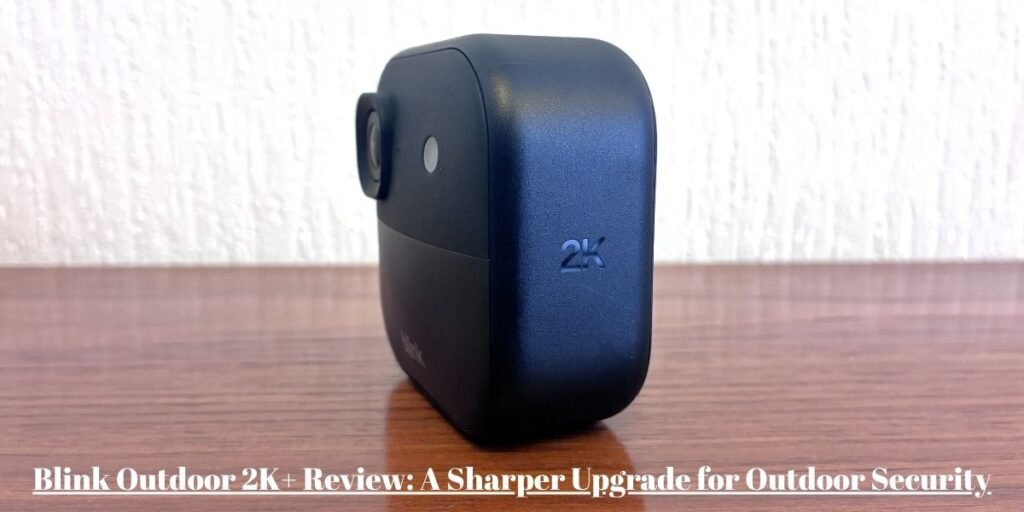
A jump in resolution changes how a budget outdoor camera holds up in real conditions. For years, entry-level battery cameras settled for 1080p feeds that smeared license plates and turned distant faces into guesswork. The Blink Outdoor 2K+ raises that baseline with a 2560 × 1440 sensor in a light wireless housing, and it keeps the long battery life Blink buyers expect. Blink’s own technical specifications page lists the camera at 70 × 70 × 41 mm and 142 g (5.0 oz), small enough to disappear into a porch corner.
Pricing needs a careful read. TechRadar‘s review puts the list price at $99.99 in the US (£89.99 in the UK) and notes that the camera launched in October 2025. Earlier coverage and some retailer listings have quoted a lower figure of $89.99, so check the live Amazon listing before you buy. Blink discounts constantly, and single-camera kits have dropped to roughly $34.99 during sales events. Multi-camera bundles have been listed at about $129.99 for two cameras and $349.99 for five cameras before discounts. Treat those bundle figures as a starting point, because they move often.
What’s New With the Blink Outdoor 2K+
The first thing you notice is clarity. Moving from the 1080p ceiling of the Blink Outdoor 4 to 2K gives you nearly double the pixel count, and that extra detail keeps text legible and outlines distinct at typical yard distances.
Blink also reworked the low-light behavior. The camera now relies on ambient light to hold Color Vision in low light and only falls back to infrared black and white when the scene gets too dark. Blink’s spec sheet carries a clear caveat: ambient light is required for color, and without enough of it, the camera may default to infrared. That matters in practice. A yard with a porch light or a streetlamp nearby will give you color footage well into the evening, while a pitch-black side yard will not.
The package also ships with the new Sync Module Core, which replaces the older Sync Module 2 as the bridge between your cameras and your home network. It runs on 2.4 GHz Wi-Fi (802.11ax), and Blink recommends WPA3 security where your router supports it. This module is also where the biggest trade-off of the whole product sits, which I cover in the storage section below.
2K Video Quality in Daylight and at Night
Daylight footage shows the clearest improvement. Blink specifies a field of view of 115° horizontal, 62° vertical, and 135° diagonal, and the 2560 × 1440 image holds enough detail for faces and vehicle tags in the typical range of a driveway or front yard. Where older 1080p models turned distant text into blocky shapes, this sensor leaves room for 4x digital zoom. TechRadar‘s reviewer noted that the zoom softens as you push in, which is the nature of any digital zoom, but it still picked out distinguishing features and marks during test scenarios.
Contrast handling is the quieter win. Bright driveway asphalt is less likely to wash out a covered porch beside it, so you can still follow movement in the shadows.
Night performance runs in two modes. Near streetlamps or porch lights, Color Vision keeps coat colors, hair shades, and vehicle paint accurate. In full darkness, the 850nm infrared LEDs take over and produce monochrome footage. I would treat a working range of around 20 feet as a reasonable planning estimate, since Blink’s spec page does not publish a firm distance. If you need real color after dark, Blink sells a separate Outdoor Floodlight Mount that is compatible with this camera.
There is one more setting worth understanding. Blink lets you pick between 2K (Best), 1080p (Standard), and 720p (Saver). Your internet connection matters here, because Blink lists minimum upload speeds of 6 Mbps for 2K, 3 Mbps for Standard, and 2 Mbps for Saver. If your upload speed is weak, the 2K mode is where problems will show up first.
Motion Detection and Person Alerts
Motion detection relies on a passive infrared sensor that reacts to heat signatures. TechRadar described motion detection as razor-sharp but noted that the default settings felt overzealous. I agree with that assessment as a general rule for this category. Spend ten minutes in the app setting activity zones and lowering sensitivity, and block off tree limbs, sidewalks, and street lanes. That single step prevents most of the notification fatigue people complain about.
Basic motion alerts, live view, and two-way talk work without a subscription. Smart detection does not. Person and vehicle detection require a paid plan, and these are the features that stop your phone from buzzing every time a fox crosses the lawn.
Blink sells two tiers, and both include up to 60 days of cloud storage (up to 30 days in the UK and EU):
- Blink Basic costs $3.99 per month or about $39.99 per year and covers one device. It includes motion-event recording, live-view recording, instant video access, video sharing, person detection, and photo capture.
- Blink Plus costs $11.99 per month or about $119.99 per year and covers unlimited devices at one location. It adds Moments capture, notification snoozing, and a 10% discount on Blink devices.
Those monthly prices are confirmed in the TechRadar review. The annual figures follow Blink’s usual pricing pattern, so confirm them in the app before you commit.
Battery Life and Outdoor Installation
Battery life remains the headline feature. Blink rates the camera for up to two years on the two included Energizer Ultimate Lithium AA batteries, which are non-rechargeable. The fine print matters, though. Blink’s spec page states that the two-year figure is based on battery efficiency settings with 1080p resolution and typical use. Running the camera in full 2K, lengthening clips, and placing it where traffic triggers it all day will shorten that number. I would plan for something closer to 9 to 15 months in a busy location. That is my own estimate rather than a Blink figure, and it assumes heavy use, so a quiet side yard could do much better. TechRadar‘s reviewer was upfront that a two-year claim cannot be verified in a few weeks of testing, and I would take any review that claims otherwise with caution.
Installation is straightforward. The housing carries an IP65 rating against rain and dust, and Blink lists an operating range of -4°F to 113°F (-20°C to 45°C). Mounting takes two screws on a wall, fascia board, or trim post. TechRadar reported setup in under 10 minutes with no cabling, though the reviewer did hit some teething problems connecting to a home Wi-Fi network. If that happens, check that your phone is on the 2.4 GHz band during pairing.
For locations where battery swaps would be a nuisance, the camera has a USB-C port and works with Blink’s separately sold Weather Resistant Power Adapter for continuous power. It is also compatible with existing Outdoor 4 accessories such as the floodlight mount and the battery extension pack, so owners of the older system can reuse what they have.
How Blink Handles Video Storage
Storage is where this camera gets complicated, and it is the part of the original Blink story that has changed the most.
The Sync Module 2 was popular with subscription-averse buyers because it had a USB port. You plugged in a flash drive of up to 256GB, and clips were saved locally with no monthly fee. The new Sync Module Core that ships with the Outdoor 2K+ has no USB port. TechRadar called this the real kicker of the product and pointed out that without local storage, the free experience shrinks to live view and motion alerts.
There is a workaround. Blink states that the Outdoor 2K+ is compatible with all Sync Modules, and TechRadar confirmed that an older Sync Module 2 still works if you already own one. If local storage matters to you, that is the route to take. Most new buyers will end up with the Core, though, and will need a plan.
A subscription unlocks a lot. It adds cloud recording, instant video access, clip sharing, person and vehicle detection, and on the Plus tier, Blink Moments, which stitches events from several cameras into one timeline. There is also a limitation I would flag for anyone who likes reviewing footage on a big screen: there is no browser or desktop viewing, so everything happens in the mobile app.
Blink Outdoor 2K+ vs. Blink Outdoor 4
The upgrade comes down to resolution, audio, and storage. The Outdoor 4 tops out at 1080p, while the 2K+ delivers 2560 × 1440 and keeps more detail at a distance.
Audio improves too. The 2K+ adds noise cancellation to its two-way audio, which reduces wind, traffic rumble, and HVAC hum during live conversations. For doorstep exchanges, that makes a noticeable difference.
If you already run an Outdoor 4 system, replace the cameras that watch the widest areas first, such as a long driveway or the street view. For close-range spots like side walkways and sheds, 1080p footage is still fine. One more point favors holding onto your older gear: if your Outdoor 4 setup uses a Sync Module 2 with a flash drive, keeping that module in service preserves your free local storage, and the 2K+ will work with it.
Is the Blink Outdoor 2K+ Worth It?
As a camera, it is a clear step forward. The 2K resolution, improved color in low light, noise-canceling audio, and AA lithium battery life fix the weaknesses of earlier Blink models. TechRadar scored it 3.5 out of 5 for value, 4 out of 5 for design, and 4 out of 5 for performance, calling it the best budget outdoor option Blink has made. I think that verdict is fair.
As a package, the picture is more mixed. The bundled Sync Module Core removes the free local storage that attracted many buyers to Blink in the first place. If you plan to subscribe anyway, the camera is easy to recommend, particularly for first-time buyers in the Amazon Alexa ecosystem. Blink remains Alexa-only, with no Matter or HomeKit support, so anyone building around Apple Home or Google Home should look elsewhere.
If you want free cloud storage or subscription-free person detection, compare other brands before buying. If you already own a Sync Module 2, or you are happy to pay a few dollars a month, the Blink Outdoor 2K+ stands as a very capable budget outdoor camera.