
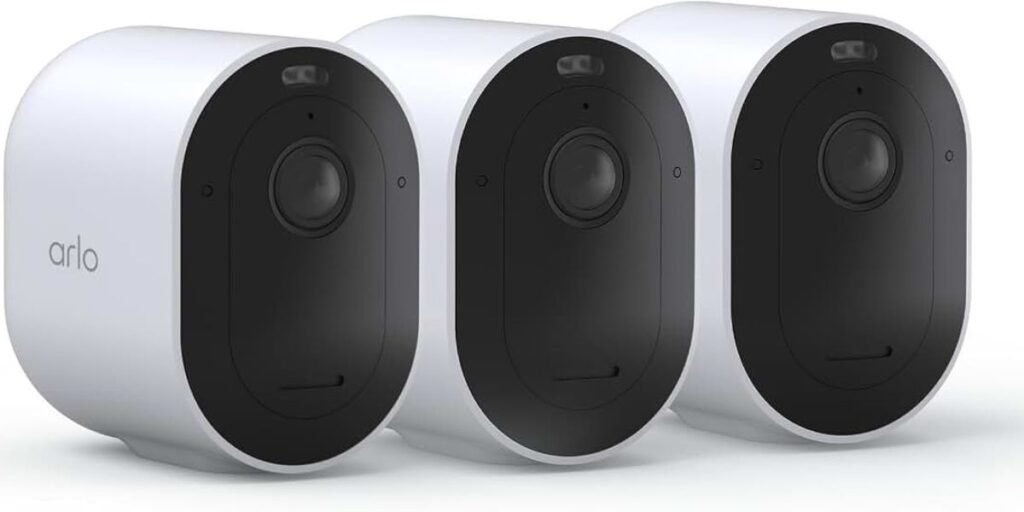
Outdoor security cameras live or die by three things: image resolution, day-to-day reliability, and how fast they react when something actually happens. A spec sheet can promise sharp footage, but that promise falls apart the moment headlights sweep across the lens at 11 p.m., a rainstorm rolls through, or a person cuts across the yard faster than the sensor can keep up.
The Arlo Pro 5S 2K sits in the premium end of the battery-powered camera market, built around 2K HDR video, dual-band Wi-Fi, and Arlo’s own SecureLink networking. First released in October 2023, it has spent significant time on real driveways and porches. Testing outlets that have mounted it outdoors, including Tom’s Guide, have logged enough hands-on time to separate marketing language from what the hardware actually delivers. What follows is a close look at how it handles resolution, low light, field of view, and battery life once it is bolted to a wall and left to do its job.
Arlo Pro 5S 2K Specifications
Before judging how a camera performs outside, it helps to know exactly what sits inside the housing.
The camera records at 2560 x 1440 resolution (2K), encoded in a 16:9 aspect ratio with HDR processing. Its capture rate runs at 24 frames per second during the day, dropping to 15fps at night according to tested specs. The listed model number on Arlo’s spec sheet is VMC4060P, and the housing itself measures 3.5 x 2 x 3 inches, featuring an oblong shape that is rounded at the back and flat up front.
The lens delivers a 160-degree diagonal field of view with automatic digital de-warping built into the firmware, plus up to 12x digital zoom you can pinch into while reviewing live or recorded footage. Night vision runs through a pair of 850nm infrared LEDs for standard black-and-white capture, alongside a built-in spotlight measured at 100 lumens total, which triggers color recording after dark.
On the audio side, there is a built-in speaker and microphone for two-way talk, along with an integrated 80dB siren that can be triggered manually from the app or set to sound automatically based on motion or audio detection.
Power comes from a removable, rechargeable battery pack charged through magnetic contact pins on the underside of the housing, so you do not have to unmount the whole unit to top it up. The camera is also compatible with the Arlo XL Rechargeable Battery & Housing and Arlo Solar Panel accessories. Wireless connectivity runs on 802.11 b/g/n Wi-Fi across both 2.4GHz and 5GHz bands.
Weatherproofing holds an IP65 rating. Unlike some earlier Arlo models, the Pro 5S 2K connects directly to your home Wi-Fi router and does not require a SmartHub or Base Station to function, though adding one unlocks local storage options.
Retail pricing launched at $250 for the standalone camera, which remains the standard list price directly from Arlo or at retailers like Amazon and Best Buy for a new unit. Discounted pricing frequently drops below that baseline into the $90 to $165 range depending on color options and ongoing promotions.
2K Video and HDR
Judging 2K resolution outdoors takes more than counting pixels on a spec sheet. A 2560 x 1440 frame packs roughly double the detail of standard 1080p Full HD, which matters most when you crop into a clip after the fact to check a face or a delivery label.
In daylight, that extra resolution shows up clearly on static backgrounds and anything moving at a normal walking pace. Facial features, clothing patterns, and logo details on a delivery uniform hold up well within about 15 to 20 feet of the lens. Push a subject farther than that and clarity naturally drops off, simply because fewer pixels are left to describe a smaller shape in the frame. Hands-on testing over several weeks logged footage with accurate color reproduction in the middle of the frame, alongside occasional overexposure near the top corners, which is a common trade-off with wide, HDR-heavy lenses.
HDR processing carries this camera through harsh outdoor lighting. A driveway in direct sun next to a shaded porch is exactly the kind of scene that trips up cheaper sensors, leaving you with blown-out pavement and a pitch-black doorway. The Pro 5S 2K’s HDR pulls both ends back into a usable range, ensuring a face stepping from sunlight into shade does not disappear into silhouette.
One detail requires managed expectations: the 12x zoom is digital, not optical. It crops and enlarges pixels that are already captured rather than adjusting physical glass to gather more detail. That works fine for confirming a package is sitting by the door, but it proves less reliable for reading a license plate on a car parked 30-plus feet down the street, where pixelation takes over.
Video resolution is also tied directly to the selected power mode in the Arlo Secure app. Setting the profile to Best Video captures full 2K at the cost of battery life, while lower-power settings trade image quality for longer runtime between charges. Understanding that operational trade-off upfront prevents confusion if footage ever looks softer than expected.
Color Night Vision and the Built-In Spotlight
The camera splits night recording into two distinct modes depending on lighting conditions and configured settings.
Standard infrared vision runs through the two 850nm LEDs, working silently and invisibly out to roughly 25 feet in full darkness. This mode records in black-and-white, picking out movement and outlines across an open yard even while losing color context like clothing shades or vehicle paint tones.
Color night vision activates once the built-in spotlight switches on and floods the immediate area with white light, pulling the sensor out of monochrome mode. Full color at night allows you to identify a jacket shade, hair color, or vehicle paint, providing details that plain infrared cannot capture.
The trade-off shows up with fast motion. The operational drop to 15fps at night introduces visible motion artifacts around moving objects compared to daytime capture. Someone jogging past the frame in full color at 2 a.m. may show ghosting around their hands or feet, even while a person standing still under the spotlight looks crisp and detailed.
Infrared remains the better choice in busy alleys, near bedroom windows where sudden light bursts cause disruptions, or in rural settings where firing the spotlight repeatedly drains the battery quickly. The spotlight earns its keep closer to entry doors or side gates, where a burst of white light doubles as an active physical warning.
160° Field of View for Outdoor Areas
A wide lens angle changes how much ground a single camera can realistically cover, representing a key area where the Pro 5S 2K competes against alternatives.
The 160-degree diagonal field of view is notably wider than competitors like the Ring Spotlight Cam, which tops out at 140 degrees. In practical terms, that difference lets one camera mounted above a two-car garage take in the full driveway width, a side gate, and the front walkway all at once, whereas a narrower lens would need a second camera to fill the gaps.
Mounted near a front porch, that same wide angle covers the main entry door while catching ground-floor windows to either side. Built-in software correction removes the fisheye bending that wide lenses are prone to, keeping vertical lines like porch posts and fence rails straight instead of curving toward the edges of the frame.
The catch with any wide-angle lens involves pixel density. Spreading a 2K sensor across 160 degrees means objects at the edges of a large yard occupy fewer pixels than they would through a tighter 130-degree lens. That makes the camera excellent at catching activity across a wide footprint, but reading fine detail at long range requires mounting it closer to primary coverage targets.
Battery Life and Wireless Installation
Power management and signal strength determine whether a wire-free camera remains convenient or turns into a recurring maintenance task.
Battery consumption varies based on physical placement and daily activity. Running the camera in Optimized mode over 10 days typically results in a 30 percent drop in battery charge while capturing full 2K video, providing a realistic baseline for moderate deployment. Heavy motion zones, such as a camera pointed at a busy sidewalk, or frequent spotlight activation at night burn through power noticeably faster.
The Arlo Secure app features four operational power profiles: Best Video, Optimized, Best Battery Life, and Low Power Mode. The Low Power Mode setting stops recording continuous video altogether and switches strictly to capturing still photos when motion triggers, serving as a safeguard against dead batteries. You can also configure the camera to switch into Low Power Mode automatically once battery levels drop between 10 and 30 percent.
Charging operates via magnetic contact pins built into the housing underside, meaning a top-up does not require unmounting the bracket from the wall. For permanent power setups without manual charging cycles, the unit pairs with the Arlo Solar Panel accessory or the XL Rechargeable Battery & Housing.
Dual-band Wi-Fi provides network flexibility. The 5GHz band delivers faster throughput and quicker live-stream loading when the camera sits close to a router. Switching to the 2.4GHz band provides better signal penetration through brick, stucco, or vinyl siding over longer distances, maintaining a stable connection even if network speed drops slightly.
Placement requires mounting the camera 7 to 9 feet high and angled slightly downward. This positioning avoids direct sun flare hitting the lens during golden hour while keeping the physical housing within easy reach for battery servicing.
Arlo App and Smart Detection
Capturing clear video matters little if the notification system fails to filter out environmental motion.
The Arlo Secure app processes motion into distinct categories, flagging person detection, vehicle detection, animal detection, and package detection separately rather than sending generic alerts. Distinguishing a delivery truck from a moving tree branch cuts down on alert fatigue during high-wind conditions.
Custom Activity Zones allow you to draw boundaries directly over the camera’s view, enabling alerts over porch steps while ignoring street traffic passing in the background. Package detection is limited to one camera per account, so it should be reserved for the primary entryway camera.
The app supports three central security profiles:
- Armed Mode: The camera actively records and alerts on all configured motion events.
- Home Mode: The camera records footage normally but suppresses phone push notifications while occupants are inside.
- Standby Mode: Monitoring, video recording, and alert triggers are fully turned off.
These modes can be automated using custom schedules or phone location geofencing. When triggered, alerts deliver rich, interactive notifications with a video preview directly on the lock screen, alongside optional Auto Zoom and Tracking to follow moving subjects across the frame.
For active deterrence, the app controls the built-in 80dB siren, allowing remote manual triggers or automated alarms tied to an armed profile. Two-way audio uses active noise reduction to suppress wind shear and ambient outdoor noise during live calls.
Arlo Secure and What You Get Without a Subscription
Understanding where free hardware features end and paid service features begin is essential before buying, as the gap between the two is substantial.
Without a subscription, the camera handles essential baseline tasks: live HD/2K streaming, motion push alerts, two-way audio, and manual spotlight or siren controls. However, operating without a plan means there is no cloud video storage. Once a motion alert passes, you cannot review historical clips unless an optional hardware hub is added.
Subscribing to Arlo Secure unlocks the complete feature set. Current pricing tiers sit at $7.99 per month for a Single Camera plan, $12.99 per month for unlimited cameras under Arlo Secure Plus, and $19.99 per month for the Total Security tier, which adds 4G cellular backup capabilities.
Paying for a plan provides 60 days of rolling cloud video history, advanced AI detection (people, vehicles, animals, packages), custom cloud activity zones, and animated preview thumbnails on lock screens. While it expands overall functionality, ongoing costs should be budgeted alongside initial hardware pricing.
Local Storage With the Arlo Pro 5S 2K
The camera housing contains no onboard microSD slot, so local storage requires adding external hub hardware.
To record locally, the Pro 5S 2K must pair with a compatible base, such as an Arlo SmartHub (VMB4540 or VMB5000) or an older Base Station (VMB4000 or VMB4500). These hubs connect to your router via Ethernet and host external USB drives or microSD cards. Adding a SmartHub typically costs around $100.
Using local hardware ensures video footage continues recording locally even during internet outages, appealing to users who prefer keeping video data inside their physical residence. However, local storage does not fully replace cloud convenience. Reviewing stored local footage remotely requires setting up port forwarding or a home network VPN, and local playback interface lacks cloud smart thumbnails and AI categorization filters.
Arlo Pro 5S 2K Outdoor Performance
Hardware specifications translate directly into distinct operational characteristics when deployed across real exterior environments.
Daytime Outdoor Video
In bright sunlight, the camera holds clear detail across yards and driveways. The HDR engine balances harsh contrast, keeping subjects legible when they move through deep tree shadows or covered porch overhangs. Vehicles pulling into driveways maintain clear badging, body color, and bumper detail, while the 24fps daytime capture rate keeps movement smooth over solid Wi-Fi connections.
Nighttime Outdoor Video
After dark, operational fidelity depends on the active lighting mode. Infrared illumination cleanly covers open yards out to 20 feet, maintaining a low profile while logging high-contrast subject outlines. Engaging the spotlight activates color night vision, making clothing colors, hair shades, and vehicle paint visible. The frame rate drop to 15fps at night can introduce mild motion blur on fast-moving subjects, though static subjects remain clear under direct light.
Coverage Around the Property
Mounting the 160-degree lens above driveways or front entryways covers wide physical areas without requiring a second camera. A single unit can monitor a side walkway and a garage entrance simultaneously without needing motor-driven panning capabilities.
Software de-warping keeps porch pillars and fence lines straight, preventing distortion. This wide perspective performs best when installed within 15 feet of primary monitoring zones, balancing wide perimeter coverage with subject readability.
Arlo Pro 5S 2K Pros and Cons
Pros
- 2K HDR video delivers sharp daytime detail and balances high-contrast outdoor lighting.
- 160-degree field of view covers wide property footprints from a single mounting point.
- Color night vision with integrated spotlight captures clear subject color details after dark.
- Dual-band Wi-Fi (2.4GHz and 5GHz) offers flexible placement options across varying router distances.
- IP65 weather rating handles standard outdoor weather conditions without additional housing.
Cons
- Cloud video storage, AI object detection, and activity zones require a paid Arlo Secure subscription.
- Local storage requires a separate SmartHub or Base Station, adding roughly $100 to the initial setup cost.
- Battery drain accelerates under high motion activity and frequent spotlight triggers.
- Nighttime 15fps recording can cause minor motion artifacts on fast-moving targets.
Is the Arlo Pro 5S 2K Worth Buying?
The Pro 5S 2K justifies its price point through video resolution, wide field of view, and installation flexibility. Combining 2K HDR optics, a 160-degree lens, and dual-band Wi-Fi, it covers driveways, front yards, or backyards without requiring electrical wiring or multiple overlapping units.
This model is ideal for buyers comfortable using smart home ecosystems who plan to use an Arlo Secure subscription for cloud storage and smart notifications.
It is less suited for users who want to avoid recurring monthly costs or require onboard microSD card recording right out of the box. Those needing continuous, uncompressed 24/7 recording without battery maintenance may find hardwired security systems better aligned with their needs.
FAQs
Is the Arlo Pro 5S 2K really 2K?
Yes. The camera captures video natively at 2560 x 1440 resolution in a 16:9 aspect ratio, delivering roughly double the pixel detail of standard 1080p Full HD cameras.
Does the Arlo Pro 5S 2K have color night vision?
Yes, provided the integrated white LED spotlight is active. Standard infrared night vision uses two 850nm LEDs for black-and-white recording, while color recording engages once the spotlight turns on.
How wide is the Arlo Pro 5S 2K’s field of view?
The camera features a 160-degree diagonal field of view with automatic software image correction to straighten edge distortion.
How long does the Arlo Pro 5S 2K battery last?
Battery life depends on activity levels and settings. In moderate usage tests under Optimized mode, the battery drains roughly 30 percent over 10 days. Battery runtime can be extended using Low Power Mode or by attaching an optional Arlo Solar Panel.
Does the Arlo Pro 5S 2K work without a subscription?
Yes, basic features including live video streaming, motion push alerts, two-way audio, and manual spotlight or siren controls work without a plan. However, cloud video recording, AI object detection, and custom activity zones require an active Arlo Secure plan, starting at $7.99 per month for a single camera.