
A corporate fraud framework does not require an attacker to deploy advanced malware or exploit a zero-day vulnerability in software architecture. Instead, malicious actors frequently target the single highest point of leverage within an enterprise: the human decision-making layer.
When a security incident bypasses multi-million dollar perimeter defenses without triggering a single technical alert, it is usually because an adversary used social engineering to manipulate an executive. This precision-driven strategy is known as whaling.
Unlike broad, automated digital scams that cast wide nets across entry-level staff, whaling is an intelligence-driven, highly focused operation aimed exclusively at high-value targets. Senior leadership teams—including Chief Executive Officers (CEOs), Chief Financial Officers (CFOs), Chief Operating Officers (COOs), Board Members, and general counsel—hold the keys to an enterprise’s treasury, intellectual property, and strategic assets.
Understanding what is whaling in cybersecurity is no longer just a technical requirement for network administrators; it is a fundamental governance necessity for modern corporate survival.
📌 Whaling Definition
Whaling in cybersecurity is a highly sophisticated, precision-targeted form of spear phishing aimed exclusively at high-profile executives, such as CEOs, CFOs, and board members. Unlike generic phishing campaigns that prioritize volume, whaling relies on deep open-source intelligence (OSINT) gathering to impersonate trusted internal authorities or external partners. The objective is to exploit organizational trust and authority hierarchies to trick the victim into authorizing large-scale wire transfers, leaking intellectual property, or disclosing enterprise-level administrative credentials.
What is Whaling in Cybersecurity?
Whaling in cybersecurity refers to a highly targeted, specialized form of spear phishing aimed specifically at high-value individuals—the big fish—within an organization. The primary targets include executive-level authority figures who possess broad administrative privileges, financial signing authority, or access to restricted corporate data.
According to the Federal Bureau of Investigation (FBI) Internet Crime Complaint Center (IC3), these high-level corporate impersonation schemes are a primary driver of Business Email Compromise (BEC). The FBI IC3 Report highlights that BEC and whaling operations have caused globally accumulated adjusted losses exceeding $50 billion.
Furthermore, the Verizon Data Breach Investigations Report (DBIR) underscores that social engineering vectors, dominated by pretexting and executive-level targeting, account for a massive percentage of all analyzed enterprise breaches.
From an operational standpoint, a whaling attack is defined as a targeted social engineering campaign engineered to exploit executive-level authority relationships. The ultimate goal is to manipulate the target into taking high-impact actions that bypass traditional verification filters.
These actions typically include:
- Wire transfers: Directing finance teams or CFOs to authorize massive corporate fund movements.
- Credential disclosure: Compromising executive login details to gain unrestricted access to cloud ecosystems.
- Document approval: Tricking legal or operations heads into signing unauthorized contracts or intellectual property releases.
- Payroll or vendor changes: Redirecting ongoing capital streams toward attacker-controlled accounts.
Why whaling works in real enterprise environments
Whaling succeeds because it operates at the intersection of human psychology and corporate structural vulnerabilities. Attackers do not exploit software bugs; they exploit organizational trust hierarchies.
Authority Bias
Human beings are conditioned to comply with directives from perceived authority figures. In an enterprise environment, this bias is amplified. When an email appears to come from the CEO or general counsel, a subordinate or peer naturally defaults to compliance. Attackers exploit this by crafting pretexts like a “CEO requesting an urgent wire transfer” or the “Legal department demanding immediate document disclosure.”
Urgency Pressure
Social engineers intentionally introduce artificial crisis conditions to disrupt analytical thinking. By imposing tight deadlines—such as an imminent acquisition closing window, an unpaid vendor threatening legal action, or an emergency regulatory audit compliance deadline—the attacker forces the target to make a split-second decision, causing them to completely bypass established verification workflows.
Isolation of Executives
As professionals climb the corporate ladder, their operational workflows often diverge from standard staff protocols. Senior leaders frequently:
- Bypass normal internal approval chains to accelerate business velocity
- Rely heavily on administrative assistants for email triage, creating potential blind spots in communication validation
- Approve high-value transactions quickly via mobile devices while traveling, limiting their ability to thoroughly inspect email technical headers
Contextual Authenticity
Modern whaling does not rely on generic form text. Attackers perform exhaustive background research to ensure their messages carry immense contextual weight. By gathering data points from LinkedIn profiles, corporate organizational charts, recent press releases, and historical data breach leaks, threat actors inject real internal terminology, project code names, and actual vendor references into the narrative vector, making the fraudulent message look indistinguishable from daily corporate chatter.
How whaling attacks actually begin inside organizations
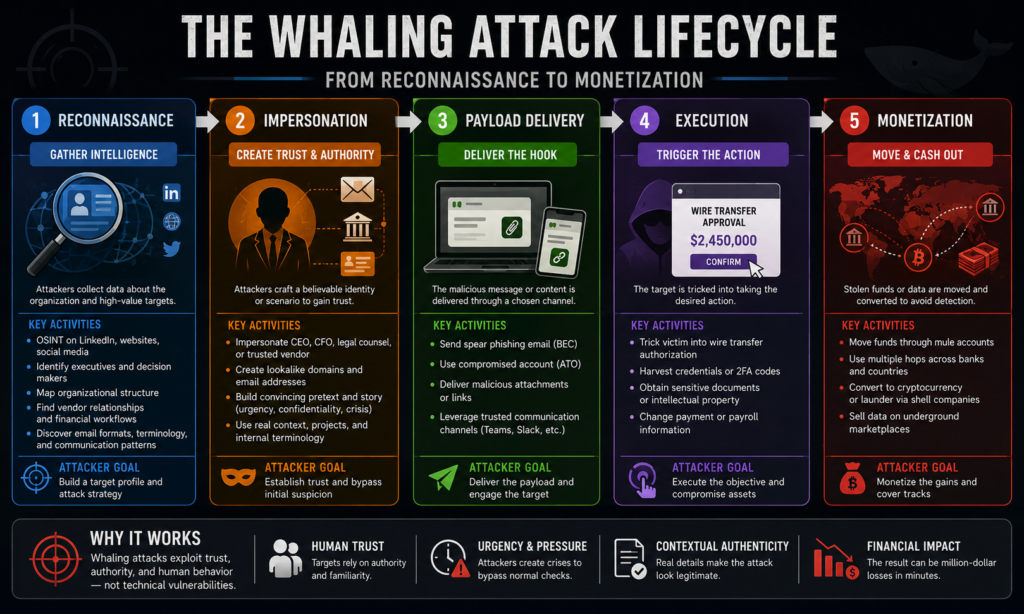
A sophisticated whaling campaign follows a structured, modular operational lifecycle. Each phase must succeed to maintain the illusion of legitimacy.
Phase 1: Reconnaissance (OSINT Gathering)
The attack begins with passive open-source intelligence (OSINT) gathering. Threat actors scrape platforms like LinkedIn, social media feeds, and company blogs to map out internal structures.
They establish exactly who holds financial approval power, locate active vendor relationships, determine CFO transaction approval thresholds, and identify the unique vocabulary used within the company. Corporate filings and data broker networks are also analyzed to enrich the target profile.
Phase 2: Impersonation Strategy
Once the organizational layout is understood, attackers determine their identity forgery method. Common pretexts include:
- CEO Fraud: Posing as the chief executive to issue a top-down order to the finance department.
- Vendor Spoofing: Pretending to be an established supplier or contractor updating payment records.
- Legal Authority Impersonation: Simulating internal or external legal counsel handling a sensitive corporate transaction.
- Law Enforcement Pretexting: Creating a fake regulatory or law enforcement emergency demanding immediate compliance.
Phase 3: Payload Delivery
The delivery vector is chosen based on the target’s technical defenses and organizational habits.
The three primary delivery methods include:
- Email-Based Business Email Compromise (BEC): Utilizing lookalike domains (typosquatting) to send fake invoice approvals or urgent wire requests that look internal but originate from outside servers.
- Account Takeover (ATO): Directly compromising an executive’s actual inbox using stolen credentials, allowing the attacker to launch highly trusted internal fraud messages directly from a legitimate corporate account.
- Malicious Attachments: Injecting stealthy spy tools or credential harvesters inside seemingly benign corporate files, such as invoice PDFs, contract documents, or HR spreadsheets.
Phase 4: Execution Objective
The target, under the influence of psychological manipulation, completes the attacker’s goal. This manifests as authorizing an unverified wire transfer, diverting an executive payroll stream, entering credentials into a spoofed landing page, or leaking sensitive contract files and trade secrets.
Phase 5: Monetization
The moment the assets are compromised, the attacker moves to secure them. Stolen corporate funds are rapidly routed through a dynamic web of pre-arranged mule accounts, shifted across international shell companies, or converted through digital currency nodes to break the audit trail and prevent traditional bank recovery actions.
Real-world whaling attack cases
Case 1: Crelan Bank (Belgium) – $75M Loss
In one of the most cited classic whaling incidents, Belgian financial institution Crelan Bank was hit by a highly sophisticated CEO impersonation attack. Over an extended period, threat actors successfully mimicked the Chief Executive Officer, targeting specific financial staff members who possessed high-volume transfer capabilities.
By maintaining an illusion of extreme confidentiality and manipulating internal audit awareness, the attackers convinced staff to execute a series of unauthorized transfers, resulting in a staggering $75 million financial loss.
Case 2: Corporate Vendor Fraud via Invoice Manipulation
A rapidly expanding variant of whaling involves the targeted interception of the corporate supply chain. In a notable global trend, threat actors gain access to internal vendor communications and quietly monitor transaction cycles. When a high-value invoice is due, the attacker steps in using a lookalike email account, providing updated banking and routing info.
The client enterprise, believing they are paying their long-term partner, transfers millions directly to the cybercriminals’ accounts before the deception is discovered during regular reconciliation cycles.
Case 3: The Remote Work/COVID-Era Executive Fraud Surge
The rapid shift to distributed corporate environments significantly weakened internal operational checks. During this period, attackers launched highly coordinated whaling campaigns featuring fake corporate video invite links.
By exploiting the isolation of distributed finance teams, threat actors simulated top-down orders from leadership, pressuring isolated employees into bypassing standard validation protocols and authorizing millions in emergency payments under the guise of business continuity protection.
Case 4: Modern AI-Enhanced Whaling
Recent threat intelligence data highlights a major shift in technical sophistication. Threat actors now actively deploy customized generative AI systems to analyze public social media content, interviews, and corporate filings belonging to specific executives.
In controlled testing environments, these AI-generated phishing emails continuously outperform human-written messages in persuasion tests. By automating writing tone replication and personal context injection, adversaries have turned whaling from a manual craft into a highly scalable, automated crime model.
Types of whaling attacks seen in real environments
Whaling operations manifest across several distinct technical and operational frameworks:
- CEO Fraud (Classic BEC): The most common format. The communication vector mimics a top-down directive from the CEO straight to the finance department, demanding an urgent, confidential wire transfer.
- Vendor Email Compromise (VEC): An attack that intercepts external corporate networks, altering supplier invoice records or changing deposit bank details to hijack business-to-business capital streams.
- Payroll Diversion Attacks: A targeted compromise of HR databases or corporate payroll software aimed at modifying the direct deposit information of high-earning executives, redirecting major salary allocations into fraudulent accounts.
- Legal Impersonation Attacks: Threat actors forge identities representing outside legal firms or regulatory compliance bodies, requesting sensitive corporate documents, pending acquisition filings, or employee records.
- Multi-Stage Hybrid Attacks: Advanced campaigns that begin with low-level phishing to harvest credentials, move to internal account takeover, abuse internal email trust parameters, and culminate in high-value executive financial fraud.
Why whaling is difficult to detect using traditional security tools
Whaling presents a unique defense challenge for enterprise security centers because it intentionally avoids traditional technical warning signs. The differences below demonstrate how attackers structure whaling payloads to exploit visibility gaps:
| Attack Parameter | Standard Phishing Campaign | Enterprise Whaling Operation (BEC) |
| Volume & Scale | Mass distribution across thousands of accounts. | Single-target precision focus (Low volume, high impact). |
| Technical Footprint | Contains known malicious files, exploits, or toxic URLs. | Text-only payloads relying entirely on linguistic social engineering. |
| Authentication Status | Easily caught by standard signature spam blocklists. | Bypasses SPF/DKIM via lookalike domains or compromised partner accounts. |
| Access Target | Entry-level, generic user credentials. | Executive-level authority, signing access, and privileged data. |
| Defensive Vulnerability | Effectively neutralized by multi-factor authentication (MFA). | Bypasses technical MFA by exploiting human execution channels. |
Because these attacks operate within the boundaries of normal business language, security filters frequently trust the sender domains, leaving the ultimate decision entirely to a human operating under immense psychological pressure.
Modern evolution of whaling attacks
The cybercrime landscape has evolved from isolated threat groups into an institutionalized, highly transactional economy.
AI-Powered Whaling
The integration of machine learning has dramatically minimized the traditional errors associated with social engineering. Modern AI engines grant attackers specialized capabilities:
- Seamless emulation of an executive’s distinct writing style and syntax
- Scalable language localization, allowing flawless multilingual attacks without regional grammatical tells
- Automated harvesting of LinkedIn and public database footprints to build comprehensive targeting profiles instantly
Phishing-as-a-Service (PaaS)
The emergence of commercialized attack platforms has significantly lowered the technical barrier to entry. Underground marketplaces now offer specialized whaling subscription kits. These tools come pre-equipped with ready-made CEO impersonation templates, automated target scraping scripts, and advanced adversary-in-the-middle proxy systems designed specifically to intercept session tokens and bypass multi-factor authentication controls.
How organizations detect whaling attacks
Successfully intercepting an active whaling attempt requires deploying multi-layered, behavioral detection layers at the gateway.
Email Anomaly Detection
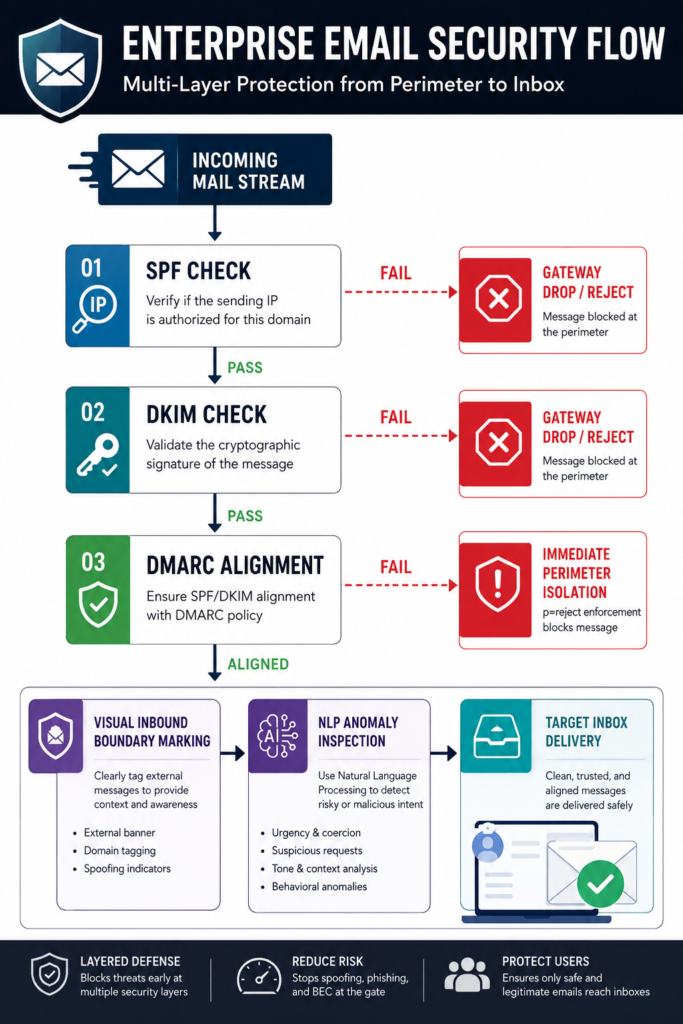
Gateway defenses must inspect deep metadata structures rather than just scanning text. Automated systems monitor for subtle technical discrepancies, such as a mismatch between the sender header and the actual reply-to address, signs of lookalike domain typosquatting, or irregular mail relay servers attempting to route messages on behalf of internal corporate names.
Behavioral Baselining
Security operations centers must establish normal communication baselines for all high-value executives. By mapping normal login locations, device profiles, and interaction hours, the system can instantly generate security flags when anomalous patterns emerge—such as a CFO suddenly requesting an urgent, high-value transfer outside regular business hours from an unrecognized IP address.
Natural Language Processing (NLP)
Because whaling is text-driven, email security solutions must utilize advanced NLP models to scan for psychological manipulation patterns. The software analyzes incoming external mail streams for linguistic markers of coercion, artificial urgency escalation, demands for absolute secrecy, or minor shifts in the executive’s historical communication tone.
Graph-Based Email Analysis
Modern detection frameworks map corporate relationship networks using graph analytics. This methodology tracks communication velocity and history across the enterprise. If an external account attempts to initiate a first-time, high-priority contact chain regarding financial parameters with a mid-level accounting clerk while claiming to be an internal executive, the graph analysis identifies the structural anomaly and quarantines the message.
How to prevent whaling attacks in enterprise environments
Protecting an organization from sophisticated executive targeting requires a comprehensive approach that integrates strict financial governance, identity verification, and hardened technical safeguards aligned with Cybersecurity and Infrastructure Security Agency (CISA) guidance.
Identity Security
Organizations must shift away from basic legacy authentication methods. Deploying phishing-resistant Multi-Factor Authentication (FIDO2/WebAuthn hardware keys) prevents threat actors from hijacking executive sessions, even if they manage to harvest passwords through spoofed landing pages. This should be coupled with strict conditional access policies that limit account access based on verified device health and geographic parameters.
Financial Controls
No technical protocol is as effective at stopping fraud as a strict corporate governance policy for workflows. Enterprises must hardcode a dual-authorization policy into their accounting systems, requiring independent confirmation for any transfer exceeding a specific financial threshold.
Furthermore, mandatory out-of-band verification procedures—such as a direct phone call via an established internal number or an in-person confirmation—must be enforced without exception, meaning no executive has the authority to waive verification rules for an urgent scenario.
Email Security Stack
Infrastructure teams must strictly configure and maintain foundational domain validation records to prevent domain forgery.
Enforcing strict DMARC policies set to absolute rejection (p=reject; pct=100) ensures that unauthorized messages attempting to spoof the corporate domain are dropped at the perimeter. This stack should be enhanced with advanced sandbox attachment scanning and automated URL rewriting engines to neutralize weaponized corporate documents before delivery.
Executive Security Hardening
Given their elevated threat profiles, senior leadership accounts require specialized handling. Security architectures should implement restricted inbox exposure rules, separate email handling channels for highly sensitive data, and explicit validation protocols for administrative assistants tasked with triaging corporate executive communication streams.
Human Factor Controls
Technical controls must be supported by targeted security awareness training. Rather than deploying generic phishing tests, enterprises must execute simulation-based whaling drills designed specifically for finance, HR, and executive teams. These exercises train high-value staff members to spot advanced CEO fraud patterns, vendor manipulation tactics, and psychological coercion techniques in a safe learning environment.
Red flags that indicate a whaling attempt
While modern social engineering campaigns are highly sophisticated, they consistently rely on a predictable set of behavioral and structural anomalies:
- Urgent Wire Requests: Any directive demanding immediate corporate fund redirection or bypassing standard accounting audits.
- Secrecy and Isolation Pressure: Explicit instructions emphasizing absolute confidentiality or telling the target to avoid checking with colleagues (“I am in a confidential meeting, do not call my office”).
- Altered Payment Details: Sudden, unexpected modifications to established supplier routing numbers, escrow accounts, or direct deposit structures.
- Subtle Domain Variations: Inbound addresses that look legitimate at a glance but feature minor misspellings or substituted characters (typosquatting).
- Executive Tone Shifts: Marked departures from an executive’s regular communication style, such as an unusual choice of words or an uncharacteristic lack of formatting.
- External Reply-To Mismatches: Messages where the sender header displays an internal corporate address, but the underlying technical Reply-To tag points to an external, unverified domain.
Conclusion
Whaling in cybersecurity is not a traditional technical attack—it is a trust-based manipulation strategy that targets the highest decision-making layer of an organization. As enterprises become more digitally connected and financially distributed, the impact of a single successful whaling attempt can be significant.
From a board-level risk management perspective, treating whaling simply as an “IT problem” is a foundational governance failure. Protecting corporate capital and data assets requires moving away from pure technical reliance toward an integrated ecosystem of strict technical authentication policies (like FIDO2 credentials and strict DMARC boundaries) coupled with unyielding out-of-band financial authorization laws.
The biggest vulnerability in any enterprise remains human trust under urgency pressure; defending it requires an organizational culture of verified validation.
Frequently Asked Questions
How does whaling differ from standard spear-phishing?
Spear-phishing targets specific individuals or small groups within an organization, such as system administrators or accounting clerks, often using technical tricks or malicious attachments. Whaling is a narrow subset of spear-phishing that focuses exclusively on senior corporate leaders, relying entirely on authoritative pretexts, executive branding, and administrative manipulation to execute high-value financial fraud.
Can automated security tools stop all whaling attempts?
No. Because whaling emails rarely contain traditional indicators of compromise—such as malicious files, exploits, or toxic web links—they appear to automated filters as standard business communication. Technology can reduce domain spoofing through DMARC, but stopping highly customized, text-only social engineering requires strict financial verification workflows.
What should an executive do if they suspect they are being targeted?
If an executive receives a suspicious or irregular request for money or sensitive data, they must immediately pause the transaction and verify the request using an independent, out-of-band communication channel, such as an established phone number or an in-person conversation. The incident should be reported directly to the internal security team along with the full, unmodified email headers for forensic review.
Why are deepfakes becoming a threat vector in whaling?
Attackers are increasingly combining text-based whaling emails with real-time AI voice deepfakes. If a CFO receives an email requesting an urgent wire transfer and then receives a follow-up phone call that sounds exactly like the CEO confirming the request, the psychological pressure to bypass traditional verification workflows increases significantly.
Is a business liable if an executive falls for a whaling scam?
Yes. Organizations generally bear the direct financial loss resulting from a successful whaling attack, as corporate funds are authorized and transferred through internal systems by employees holding legitimate access credentials. Insurance recovery varies heavily depending on the specific terms of an enterprise’s cyber insurance policy and whether they can prove they maintained rigorous financial governance controls.