
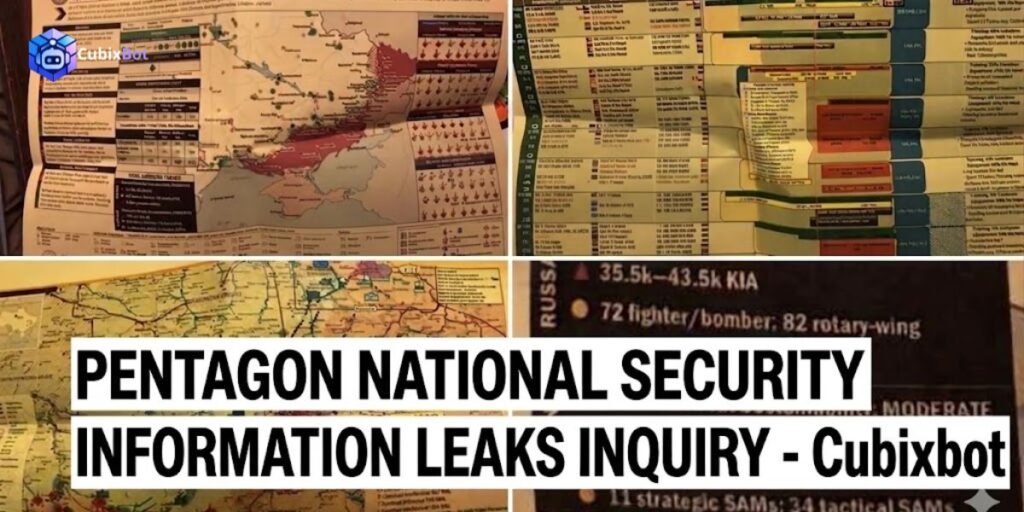
The Pentagon National Security Information Leaks Inquiry is no longer a standard counterintelligence operation; it has become a fundamental restructuring of the Department of Defense (DoD) security architecture.
As of late April 2026, the investigation has evolved from a hunt for a leaker into a systemic audit of the digital habits of the Trump administration’s highest-ranking officials.
This intelligence overview dissects the forensic reality behind the Signal-gate scandal, the fallout of the Justin Fulcher wiretap hoax, and the new era of surveillance within the E-Ring.
The Catalyst: “Signal-gate” and Operation Rough Rider
The inquiry was triggered in March 2025 by a massive security breach on Signal, an encrypted messaging app. National Security Advisor Michael Waltz inadvertently added Jeffrey Goldberg (Editor-in-Chief of The Atlantic) to a group chat titled Operation Rough Rider—the codename for strikes against the Houthis in Yemen.
The Breach of Protocol
Forensic analysis from the White House IT Office determined that Waltz had accidentally saved Goldberg’s number under the name of a staffer. Consequently, Secretary of Defense Pete Hegseth used the chat to broadcast:
- F-18 Launch Times: Specific sequencing for carrier-based strikes.
- Payload Details: The types of missiles and drone coordinates.
- Real-time Deployment: Updates shared two hours before the strikes began.
This disclosure violated DoD Directive 8100.02, which prohibits sharing non-public information on unapproved mobile applications, and sparked a criminal probe into potential Espionage Act violations.
The Justin Fulcher Hoax: A “Director of Suspicious Affairs”
While the FBI investigated the Signal leak, an internal power struggle upended the Pentagon’s front office. Justin Fulcher, a senior adviser formerly with DOGE (Department of Government Efficiency), claimed he had “smoking gun” evidence to solve the leak.
The False NSA Claims
Fulcher suggested to Hegseth’s lawyer, Tim Parlatore, that he had access to warrantless NSA wiretaps identifying the leakers. Relying on this unverified intel, Hegseth fired three veteran aides in May 2025:
- Dan Caldwell (Senior Adviser)
- Darin Selnick (Deputy Chief of Staff)
- Colin Carroll (Deputy Secretary’s Chief of Staff)
Internal investigators later discovered the wiretap was a fabrication. Fulcher, nicknamed “Disa” (a play on the Defense Information Systems Agency), had duped the Pentagon leadership.
The failure to communicate this dupe to the White House led Press Secretary Karoline Leavitt to publicly justify the firings based on nonexistent evidence, creating a massive credibility gap between the DoD and the West Wing.
Forensic Investigation Tracks (2026 Update)
The current inquiry is now segmented into three operational lanes managed by a joint task force of the FBI and the Air Force Office of Special Investigations (OSI).
1. The Panama Canal Leak
A top-secret draft memo regarding military options for reclaiming the Panama Canal was leaked to the press. The OSI identified the leaker through digital fingerprinting, noticing that the leaked version was a specific draft that lacked details found in the final SIPRNet copy. This narrowed the suspect pool to individuals with access during a specific 48-hour window.
2. The Joe Kent FBI Probe
In March 2026, the FBI escalated its probe into Joe Kent, the former Director of the National Counterterrorism Center. Kent resigned in protest of the war with Iran, and federal agents are now investigating whether he improperly shared classified intelligence to justify his departure. Unlike administrative removals, this is a criminal counterintelligence case.
3. Surveillance Expansion: The Feinberg Memo
Deputy Defense Secretary Steve Feinberg issued a draft policy in late 2025 authorizing random polygraphs for over 5,000 personnel in the Office of the Secretary of Defense (OSD).
- NDAs for All: Staffers are now forced to sign non-disclosure agreements barring the release of non-public information, not just classified data.
- The “Quantico” Mandate: Hegseth recently convened hundreds of generals at Quantico to enforce “loyalty and standards,” signaling a shift from performance-based evaluations to security-based vetting.
Expert Insight: What the Public Reporting Misses
The real story of the 2026 leak inquiry is the Access Architecture Failure. The core problem is manual transcription. High-ranking officials are physically taking data from air-gapped secure systems (SIPRNet) and manually typing it into their personal phones.
This creates a Digital Shadow that investigators are now tracking through metadata evidence (device logs and carrier pings) rather than the content of the messages themselves.
Bottom Line
The Pentagon is currently a building divided. The Hegseth Purge has silenced many internal critics but at the cost of institutional memory.
As the FBI moves toward potential indictments under the Espionage Act in late 2026, the focus remains on whether the quest for loyalty has fundamentally compromised the security of the nation’s most sensitive war plans.