
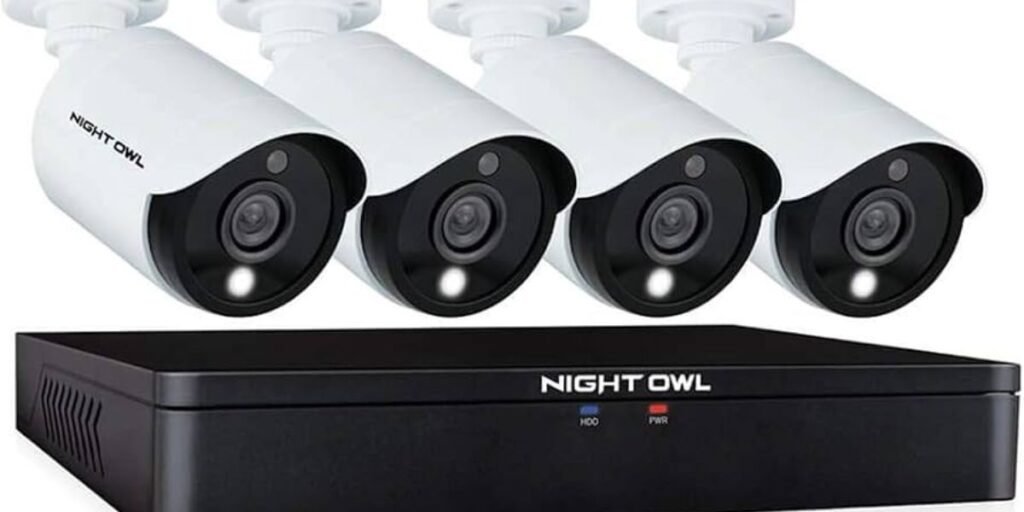
Securing the exterior of a residential property is rarely as simple as purchasing a random box of hardware off a shelf and screwing it to the nearest piece of siding. Real-world property protection demands a deliberate evaluation of structural blind spots, local Wi-Fi propagation limits, and changing weather patterns across different seasons.
The security hardware market has evolved far beyond a single type of fixed-lens camera. Night Owl now distributes a broad equipment lineup that spans traditional plug-in Wi-Fi models, battery-powered wire-free units, self-sustaining solar configurations, active-deterrence spotlights, crisp 2K resolution options, and expansive 4K-ready hub networks.
Choosing the right equipment requires moving past marketing specifications printed on retail packaging. The best Night Owl wireless camera is the specific unit whose internal power source, optical night-vision range, physical coverage field, and local recording architecture match the unique layout of your home.
What makes Night Owl wireless security cameras different?
Navigating the Night Owl ecosystem requires separating the concept of data transmission from physical power delivery. A common point of confusion among buyers is assuming that any camera labeled wireless operates entirely without cables.
Wireless connectivity simply means the device transmits digital video streams through the air via Wi-Fi networks to a router, a dedicated security hub, or a local network video recorder. However, a plug-in wireless camera still requires a permanent physical electrical wire plugged into an AC wall outlet for continuous operation.
Wire-free cameras, by contrast, eliminate power cords entirely by running on internal rechargeable lithium-ion battery packs or auxiliary solar attachments. Night Owl official support literature maintains a clear structural separation between these deployment types, matching traditional plug-in units to locations with nearby outlets and wire-free models to isolated perimeters.
Managing your security network also means interacting with the Night Owl Protect mobile application ecosystem. This platform handles remote live viewing, push notification triggers based on human or vehicle motion, local storage routing through microSD cards or recorder hard drives, and optional cloud archiving. Recognizing these operational differences ensures you choose a camera that fits your home’s physical layout rather than fighting an incompatible power source.
What the camera sees at night matters more than the 2K or 4K label
Nighttime security performance dictates the real-world value of any surveillance setup. Relying on basic marketing claims about night vision ignores the physical mechanics of how security sensors capture images after dark.
Traditional infrared night vision relies on invisible IR LED illumination arrays. These diodes flood the field of view with light wavelengths invisible to the human eye, allowing a monochrome digital sensor to resolve shapes and motion in absolute darkness.
Modern consumer cameras frequently utilize full-color low-light technology. These systems combine sensitive image sensors with visible illumination or physical spotlights to generate full-color nighttime footage instead of traditional black-and-white images.
The integrated spotlight serves an active security function rather than acting as a simple architectural light fixture. When motion sensors trip, the bright LED array illuminates trespassers, switches the digital sensor to full-color mode, and serves as an immediate physical deterrent.
Manufacturer night-vision distance ratings must be evaluated realistically. Night Owl specifies certain infrared models with ranges up to 100 feet, while compact 2K wire-free spotlight configurations often advertise 60-foot effective ranges paired with wide 105-degree viewing angles.
Property owners must distinguish between three distinct levels of nighttime visibility:
- Detecting raw movement anywhere inside the camera frame
- Recognizing that the moving shape is a human intruder
- Capturing sharp facial details clear enough for identification
A camera sensor might easily pick up movement at 80 feet, but positive facial identification requires the target to be much closer to the lens under adequate secondary illumination.
Resolution is only part of the image-quality equation
Shoppers frequently fixate on pixel counts like 1080p, 2K, or 4K, assuming that higher figures automatically guarantee superior evidence collection. In practice, digital resolution is only one component of a complex optical equation.
True imaging performance depends heavily on structural variables:
- Horizontal and vertical field-of-view dimensions
- Optical sensor quality and low-light sensitivity
- Ambient property lighting and auxiliary spotlight output
- Video compression efficiency and bitrates
- Distance between the camera lens and the target zone
- Mounting height and downward tilt angle
A 2K resolution camera is typically ideal for standard residential entryways, side gates, and garage approaches, delivering sharp visual detail without clogging home Wi-Fi bandwidth. 4K capability becomes genuinely useful when monitoring massive open properties or sprawling driveways where digital zoom must retain edge definition.
However, a poorly positioned 4K camera pointed directly into glaring sunlight or mounted too high can yield less usable evidence than a properly adjusted 2K device. Night Owl distributes hardware across multiple resolutions, pairing flexible 2K wire-free cameras with robust 4K-ready NVR hubs to balance clarity and network performance.
The Night Owl wireless cameras worth considering
Selecting security hardware requires evaluating how specific models operate under real outdoor conditions rather than scrolling through generic star ratings. Night Owl manufactures distinct device configurations designed around unique residential layouts, power constraints, and monitoring objectives.
Rather than treating every camera as a universal solution, you have to match the hardware to your physical reality.
Night Owl BW4 2K Wire Free Spotlight Camera
The Night Owl BW4 2K Wire Free Spotlight Camera represents a strong entry point for property owners who need flexible outdoor placement without running permanent low voltage cables along exterior walls.
Current specifications for the BW4 series include 2048 x 1080 2K resolution, Wi-Fi IP connectivity, and a wide 100 degree field of view. It also features two way audio, up to 100 foot night vision, dual LED spotlights, rechargeable lithium ion batteries, and IP65 weather resistance. Depending on your setup, you can record footage directly to a microSD card, a compatible recorder, or an optional cloud storage plan.
Homeowners should buy this model when they need reliable outdoor coverage in areas where running a physical power cord is structurally impossible. The inherent trade off comes from battery power. The convenience of a wire free installation means your final mounting position must account for periodic physical access to recharge or swap the battery pack.
Night Owl BWNIP4 2K Wire Free Spotlight Camera
When you need a more robust feature set for active intrusion deterrence, the Night Owl BWNIP4 2K Wire Free Spotlight Camera provides a heavier security approach.
The current BWNIP4 listing steps up the hardware capabilities with 2560 x 1440 2K video, two way audio, an active motion triggered spotlight, and audible siren audio alerts. It delivers a 100 foot color night vision range, a wider 105 degree viewing angle, a rechargeable battery configuration, and durable IP65 weather resistance.
You choose this model over the base unit when visual and audible deterrence genuinely matters. The added siren and brighter color night vision make this specific camera highly relevant for front entrances, vulnerable side yards, and long driveways where stopping a trespasser is more important than simply recording them.
Night Owl BW4 Solar 2K Camera
This model deserves separate attention because it solves the biggest flaw of wire free cameras. The Night Owl BW4 Solar 2K Camera eliminates manual battery charging by integrating continuous passive power generation.
The BW4 solar specification mirrors the standard model with 2K resolution, a 100 degree field of view, two way audio, up to 100 foot night vision, and dual LED spotlights. However, it includes an integrated 1W solar panel that constantly feeds the dual rechargeable batteries. It also maintains IP65 weather resistance and supports microSD, recorder, and cloud storage options.
Solar assisted cameras are genuinely useful for high mounting positions overlooking driveways or large backyards where climbing a ladder repeatedly to charge a battery would be tedious. It is not ideal for deeply shaded mounting locations under thick tree canopies or heavy roof overhangs where the panel cannot harvest enough daily sunlight to sustain the battery.
Night Owl FWR8 Wi-Fi Security Hub with wire-free cameras
Many homeowners quickly realize that shopping for a single camera does not solve a whole property security problem. They actually need a centralized management system.
Night Owl offers the FWR8 hub system specifically for this use case. Current packages bundle multiple 2K wire free cameras with an 8 channel Wi-Fi hub containing 64GB of local microSD storage. The hub allows you to expand the system up to eight compatible Wi-Fi devices. One popular current package includes three battery powered cameras alongside the central recording hub.
You choose a hub system because managing several standalone cameras on a single home router often causes massive bandwidth bottlenecks. A dedicated hub provides centralized local storage, easier physical expansion, and much more reliable large property coverage without burdening your personal internet hardware.
Night Owl FWR8 solar camera system
For homeowners who need broad outdoor coverage without the hassle of charging multiple batteries, the four camera solar package offers the best long term solution.
Night Owl lists a comprehensive four camera 2K solar wire free package paired with the 64GB microSD equipped FWR8 hub. You can also upgrade the central hub with an optional 2.5 inch SATA hard drive for massive local storage expansion.
A multi camera system becomes exponentially more valuable when your security problem involves blind spots around a large property. Combining solar power with a central hub means you achieve full perimeter coverage without running a single power cable and without climbing ladders for routine battery maintenance.
How to choose between Night Owl’s camera types
Understanding the physical products gives you a practical decision framework for your own home:
- Choose a plug-in Wi-Fi camera when electrical power is readily available nearby and you want to completely avoid regular battery maintenance.
- Choose a wire-free battery camera when running power cords would make installation physically impossible or restrict you to a terrible mounting position.
- Choose a solar-assisted wire-free model when your desired mounting position receives enough usable daily sunlight and your primary goal is to reduce charging maintenance.
- Choose a spotlight camera when active nighttime visibility and aggressive intruder deterrence are your main security priorities.
- Choose a hub-based system when you need several cameras and want centralized local storage and unified network management.
Where night vision cameras should actually be mounted
Camera placement dictates whether you capture usable evidence or useless shadows. Mounting a camera correctly requires practical geometry rather than just pointing a lens at a general area.
- Front door: Position the camera so that the visitor walks across the horizontal field of view rather than walking directly underneath a steep downward angle. You must account for clear face visibility, existing porch lighting that might cause glare, and the exact spot where delivery drivers leave packages. Avoid angles that create extreme backlighting, such as pointing the lens directly at a bright afternoon sun setting behind the visitor.
- Driveway: Driveway monitoring requires balancing coverage distance with nighttime illumination. You have to consider the vehicle approach direction and set realistic expectations for reading license plates. Harsh nighttime headlight glare will temporarily blind digital sensors. You must choose a mounting height that protects the camera from tampering while keeping the angle low enough to capture driver details before the headlights overwhelm the lens.
- Side passage: Narrow walkways require a wide field of view to capture the entire path. A common mistake is mounting the camera far too high under the roof eaves. High mounting angles severely compress vertical geometry, which reduces your ability to capture useful facial identification. Keep the camera lower to capture faces head on.
- Backyard: Backyard coverage demands strategic positioning around high risk entry points. You need to focus the lens on perimeter gates, ground level patio doors, detached storage sheds, and blind corners along fence lines.
- Detached garage: A detached garage presents a unique networking challenge because Wi-Fi reliability becomes a much bigger issue than power delivery. Your camera may have a fully charged battery or a solid electrical connection, but it will still perform poorly if the wireless connection to your home router is too weak to transmit video.
The installation details that determine whether the camera works well
A successful security deployment requires a strict workflow. Do not simply mount the camera to the wall and hope the application connects later.
Before drilling, you must verify the Wi-Fi signal strength at the exact spot you intend to mount the camera. Check local power availability if using a plug in model. Verify the physical viewing angle to ensure no tree branches block the frame. Confirm adequate daily sunlight exposure for solar models. Assess the weather exposure risk and ensure you have safe ladder access for future maintenance.
Mounting height forces you to balance vandal resistance with useful identification. Mounting the camera at 9 feet protects the hardware from someone reaching up and grabbing it. However, pushing it to 12 feet or higher ruins the camera angle and only records the tops of hats and hoodies.
Never point the lens directly toward bright outdoor security lights. Avoid facing the rising or setting sun. Keep the lens away from highly reflective metallic surfaces and ensure oncoming street traffic headlights do not shine directly into the optical sensor.
Executing the physical setup requires following the manufacturer workflow precisely. First, charge or power the camera completely. Install the correct Night Owl mobile application on your smartphone. Connect the camera or the hub according to the specific model instructions. Pair the camera directly with your network or the central hub. Verify that the live video feed is stable. Test the nighttime infrared footage in a dark room. Configure your motion detection zones and push notifications. Confirm that the system accurately records and plays back footage.
Only after completing every digital setup step should you take a drill outside and finalize the permanent physical mounting position.
Storage is part of the camera purchase
Storage architecture directly dictates how much video history your property retains. Evaluating storage capacity requirements prevents unexpected retention bottlenecks down the road.
Night Owl supports multiple distinct pathways for saving footage, including microSD cards embedded directly in the camera or hub, internal hard-drive storage housed inside network video recorders, and optional cloud backups for remote archiving. The BW4 series natively supports microSD recording, compatible recorder hard drives, and cloud routes.
Evaluating your capacity requirements depends entirely on scale. For a single front porch unit monitoring package deliveries, local microSD storage is often sufficient. For multi-camera arrays protecting a sprawling property, centralized NVR or hub hard-drive storage provides much greater reliability.
The compatibility issue buyers should check before ordering
Purchasing expansion units or mixing product generations requires careful attention to hardware pairing. Night Owl explicitly warns that add-on cameras are not universally compatible across every historical and current system family.
Before buying extra hardware, verify your exact camera model, recorder or NVR version, Wi-Fi hub generation, supported resolution limits, and maximum device channel counts. Checking these specifications beforehand avoids buying equipment that fails to pair with your existing network.
What wireless really changes during everyday use
Owning an active wireless security system introduces several routine maintenance patterns into daily life:
- Battery charging cycles: Wire-free models require periodic battery management unless paired with solar panels.
- Notification management: High-traffic zones trigger frequent push alerts that require fine-tuning motion zones.
- Wi-Fi stability: Thick exterior walls and distance from your router can degrade video streams, making network extension necessary.
- Remote monitoring: Mobile applications allow instant live viewing, but demand reliable upload bandwidth at your home internet router.
- Weather exposure: Seasonal temperature swings can impact battery chemistry and exterior housing integrity.
A practical Night Owl buying decision
| Your Situation | Better Starting Point |
| One outdoor area with no convenient power outlet | 2K wire-free camera |
| Outdoor location with consistent daily sunlight | Solar 2K wire-free camera |
| Front porch with nearby electrical access | Plug-in Wi-Fi camera |
| Need active nighttime intruder deterrence | Spotlight model |
| Several blind spots across the property | FWR8 hub system |
| Want local storage without cloud fees | Hub or NVR-based system |
| Need maximum digital zoom and image clarity | 4K-capable Night Owl system |
What I would say about Night Owl overall
Night Owl fits homeowners who want a DIY-oriented security ecosystem offering flexible wire-free or plug-in setups, local storage options without mandatory subscriptions, and advanced features like active spotlights and two-way audio.
Its primary advantage is extreme hardware variety across different property layouts. Its main consideration is ensuring that cameras, power sources, storage capacities, and hub compatibilities are mapped out correctly before placing an order.
FAQs
Are Night Owl wireless security cameras actually wireless?
Yes, but the term depends on whether you mean data transmission or power delivery. Many wireless cameras transmit video over Wi-Fi signals while still requiring a plug-in power cord, whereas wire-free models run entirely on rechargeable batteries.
What is the difference between Night Owl wireless and wire-free cameras?
Wireless cameras connect to your network without data cables but typically require a physical AC power adapter, while wire-free cameras eliminate power cords completely using internal battery packs.
Do Night Owl wireless cameras need Wi-Fi?
Yes, local Wi-Fi or a dedicated hub network is required to transmit live video feeds and push alerts to mobile devices.
Are Night Owl wire-free cameras battery powered?
Yes, they rely on built-in rechargeable batteries or auxiliary solar panels to maintain operation without external power cords.
How far can Night Owl cameras see at night?
Night-vision ranges vary by model, with standard infrared arrays reaching up to 100 feet and specific compact wire-free spotlight configurations advertising 60-foot ranges.
Is a 2K Night Owl camera enough for outdoor security?
Yes, 2K resolution provides sharp details for standard residential yards, entryways, and driveways without overwhelming home bandwidth.
Is a 4K Night Owl camera worth buying?
A 4K system is ideal for large open perimeters or wide driveways where digital zoom clarity is critical for capturing fine details.
Can I add a wireless Night Owl camera to my existing recorder?
Compatibility varies by model and system generation, so you must verify whether your specific recorder or hub supports add-on hardware.
Do Night Owl cameras require a monthly subscription?
No, local storage via microSD or hard drives allows full functionality without mandatory monthly fees.
Can Night Owl cameras record locally?
Yes, models support local recording through internal hard drives, hub storage modules, or built-in microSD card slots.
How often do Night Owl wire-free cameras need charging?
Recharge intervals depend entirely on local motion activation frequency, environmental temperatures, and daily recording volume.